







Lukashenko Calls for Strengthening CIS Economy
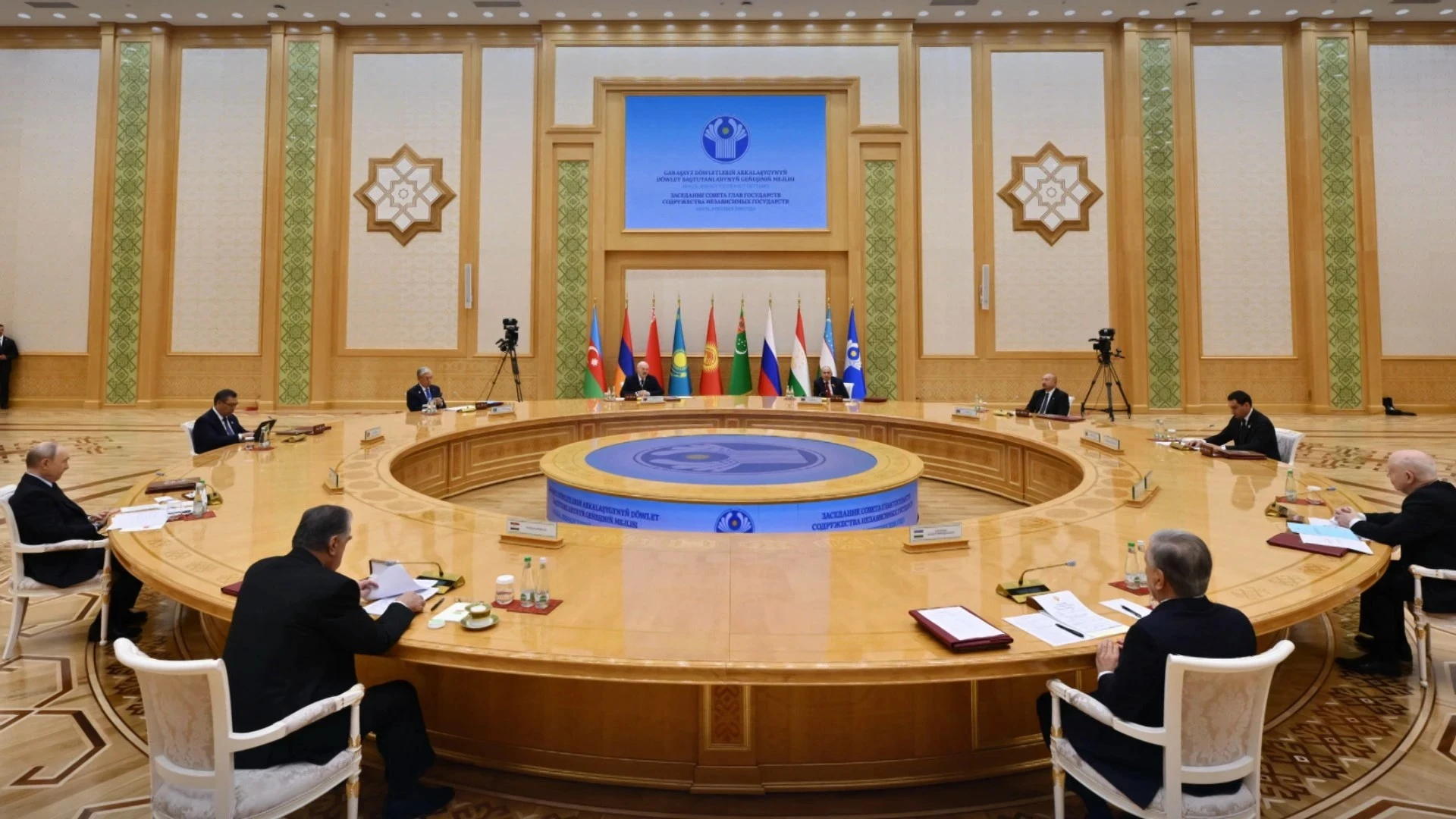
The main event of the week was the meeting of the CIS Council of Heads of State. The summit was held in Turkmenistan, and its results are being discussed today. First, the organisation is marking its 35th anniversary. The leaders signed a joint statement reviewing its work to date and outlining future prospects. They also compared views on geopolitical issues; at summits like this, many discussions take place behind closed doors.
The CIS is an association of nine countries with a shared history, and all nine leaders took part in the talks. We understand one another in many ways, and if that understanding is maintained, the economy will grow. In the first half of this year, trade within the CIS rose by about 19%. More than 90% of mutual settlements are now made in national currencies. These are tangible, measurable results from an organisation that was often predicted to fade away. There is, of course, no question of it being forgotten—and these figures are far from the limit.
The Caspian Sea was a fitting place to mark the anniversary, even though it could just as well have been celebrated in Minsk, Moscow, Bishkek, Yerevan, Astana, Baku—which is also on the Caspian—or Tashkent or Dushanbe. But Turkmenistan holds the CIS chairmanship in this landmark year, and the venue chosen was the Awaza complex, near Turkmenbashi. It is not the capital, but it can rival it in beauty.
CIS summit
The main day of talks was attended by the presidents of Azerbaijan, Turkmenistan, Kyrgyzstan, Kazakhstan, Russia, Tajikistan and Uzbekistan, the prime minister of Armenia—and, of course, the President of Belarus.
Alexander Lukashenko has consistently supported a pragmatic course of integration, stressing that without improvements in people’s prosperity, talk about borders and independence loses its meaning. In recent years, cooperation among countries in formats such as the CIS has also helped them withstand unlawful sanctions without losing ground economically.
Alexander Lukashenko noted that some countries had indeed used the Commonwealth as a tool for a more or less civilised “divorce.”
35 years of the CIS
“After the collapse of the Soviet Union, outside forces made no secret of their efforts to manipulate the newly independent states. Unfortunately, that policy continues today. Our organisation was vilified in every possible way and called a ‘geopolitical phantom’ and a ‘myth’. It was predicted to last barely a couple of months, with no one even considering the possibility that our republics might integrate,” the head of state said. “I would like to say here that our opponents made a strategic miscalculation. The reality is much more complex.”
The value of economic ties
A common market, mutual understanding across production chains, and even settlements in national currencies: the process of moving away from the dollar continues. The CIS has something to show in this regard: more than 90% of all transactions are now settled in “our own currencies.”
The CIS countries’ average annual economic growth rate is 2.1% of GDP.
Anna Velikaya, PhD in Political Science and senior researcher at the Primakov National Research Institute of World Economy and International Relations (IMEMO), Russia:
“In an era of geopolitical instability and turbulence, when trust is in particularly short supply, the arrival of CIS leaders and their meeting behind closed doors demonstrate that this format of interaction is in demand and remains relevant. It enables us to develop and move forward. The CIS countries’ average economic growth rate is currently about 2.1% of GDP annually. Some countries are recording growth of up to 10%.”
The creation of similar organisations around the world suggests that the CIS is not a phantom and that the principles on which it is based will remain in demand. These organisations act as a counterweight to American and European interests.
The value of the Commonwealth’s foundations
“The formation of a multipolar world is being driven in large part by the growing influence of BRICS, the Shanghai Cooperation Organisation, the African Union and other associations of the Global Majority. I would like the CIS to be among them,” the Belarusian leader said. “Their strengthening is supported by powerful factors: the parties’ interest in expanding trade and economic cooperation, and the need to respond jointly to today’s security challenges.”
In this context, Alexander Lukashenko believes the CIS has an advantage:
“The foundation of the Commonwealth is even stronger. We are united not only by the desire to create a fair system of global governance and trade on equal terms. Our unity is based on a shared history, cultural heritage and human ties.”
Alexander Lukashenko added:
“After all, we speak the same language. Unfortunately, we speak it—the summit participants and the older generation [of our countries]—but young people in some countries no longer know Russian, our principal language of intergovernmental communication.”
Leaders of all nine member states attended the summit
The summit was attended by the heads of all nine CIS member states—the full membership. Alexander Lukashenko often says that retreating into separate national “apartments” is not the wisest strategy. Established economic ties, industrial cooperation and joint projects are tools today, including in geopolitical competition.
Mutual respect on a political platform
“The ability of different countries and participants in global affairs to reach agreements is declining. What distinguishes the CIS from other platforms is the high degree of consensus among its members. I should also note a distinctive feature of Belarusian foreign policy—and of President Lukashenko’s foreign policy: during the conflict between Azerbaijan and Armenia, his proposals earned respect for Belarusian diplomacy and for him personally. Such respectful relations between leaders of different countries within integration or political platforms are not often seen,” says Ilgar Velizade, an Azerbaijani political analyst and columnist.
Strengthening multilateral ties
The summit addressed the need to take concrete steps towards bringing the countries closer together, strengthening multilateral ties and developing integration. The experience of leaving the CIS has so far been far from positive in terms of the “new partnerships” gained by countries that chose to do so. It has brought few clear benefits to Georgia, and even fewer to Ukraine.
The cost of leaving the CIS
Vladimir Dzhabarov, first deputy chair of the Federation Council Committee on International Affairs, cited Ukraine as an example. He said that for many years it had been at a crossroads, before ultimately deciding to turn towards the West. But, he argued, the West has provided it with nothing but weapons, because its interest lies in weakening Russia—not in preserving Ukraine or helping it withstand difficult conditions. The senator believes that concern for the people is ultimately what can be seen in these relationships.
Chisinau’s official position
The Moldovan government is now in the process of withdrawing from the CIS. In April, Moldova is set to complete the formal process. This is, of course, a shift in the country’s political course: it is heading directly towards the EU, even as France and Germany—the leading European economies—are now openly speaking out against any “accelerated integration.”
Dmitry Sinitsa, a commentator for a Russian news agency, says:
“Maia Sandu and the entire PAS party are completely indifferent to how badly their actions will damage the economy, including withdrawal from the CIS. Moldova has always been oriented towards the Russian market. It is an agricultural country, and most of its produce went to Russia. When they were breaking economic ties, including within the CIS, they were asked where they would sell their products. They said they would send everything to Europe. Europe gave them a quota, but it is so small that they cannot sell even 10% of what they grow.”
The “CIS+1” format
At the same time, countries whose interest in joining the Commonwealth would have been hard to imagine even 20 years ago are beginning to move closer to the CIS. Iran could become the “+1” in a “CIS+1” format, proposed at the summit by Masoud Pezeshkian. Iran’s key interest is to become a gateway connecting Central Asia and the CIS with open seas. Belarus has always supported welcoming new partners and building links between integration groupings.
This includes partnerships among countries that see the future in a multipolar world and are increasing their influence. China and Africa are among the clearest examples.
Competition is intensifying around the world
The President recalled that, at a recent meeting in Minsk with the heads of government of the Eurasian Economic Union countries, he had said that competition around the world was growing and “no one is waiting for us.”
“This is especially—and above all—about the economy. Let’s preserve our common space. But to preserve it, we need to increase the value of membership in this organisation for every country. Do we do that every year? No,” Alexander Lukashenko said.
He stressed that it was not only the CIS Executive Committee, but above all the large and powerful countries with substantial resources, that needed to consider making more serious decisions.
At the end of his formal address to the CIS summit, Alexander Lukashenko said that the Commonwealth countries needed to take steps to strengthen their unity, with expanding economic cooperation as the priority.
“It is good that we meet, that we have talked and looked at one another, and that we have issued a statement. It is useful for our domestic audiences to know about this. But let us take further steps towards closer unity. And it is the economy above all that will ensure our unity. It means prosperity and the strength of our states. Then there will be less talk about independence, preserving borders and so on. We need to strengthen the economy. We have serious work to do in this area, and we are ready to contribute in every way,” the Belarusian leader said.
“From a purely human perspective, I see a role for the three or four countries I have just named—the rich, the very rich countries. They should move ahead and lead our organisation. Every organisation and every team needs people at the front. You can call them leaders. Where are they? We need to move forward,” the President urged.
Transport corridors of the CIS
There are, of course, some “bumps in the road” within the CIS. Some things work very well—for example, the free trade area, which is convenient and beneficial for all its members. The abolition of customs duties on a broad range of goods traded between member states makes it easier to bring products made in Belarus or Russia into Kazakhstan or Armenia without an additional customs “tax.”
Duties remain only on a narrow list of “sensitive” goods, and that list is gradually shrinking. What else needs work? One example is a plan to connect the CIS’s transport corridors. A proposed new Aral–Caspian railway could shorten the route from China to Europe by about 1,000 kilometres and reduce delivery times by up to three days.
Elena Ponomareva, political analyst, specialist in colour revolutions and professor at MGIMO University in Russia, says:
“Turkmenistan has proposed declaring 2027 the Year of Transport Connectivity in the CIS. In my view, this is an exceptionally important area of work. But there is more to be done. Cooperation continues to develop amid change and new initiatives. The key is to identify growth drivers in time and integrate them into existing structures—perhaps modernising those structures a little—while developing new programmes.”
In conclusion, the CIS continues to evolve. If Baku and Yerevan have been able to overcome their internal conflicts and sit down at the same table, then integration certainly has a future. The countries share a long history dating back to the Soviet Union, as well as cultural and human ties. What more is needed to work effectively together for the next 35 years?