







Lukashenko: We Must Not Cross the “Red Lines” in Our Relations with Society
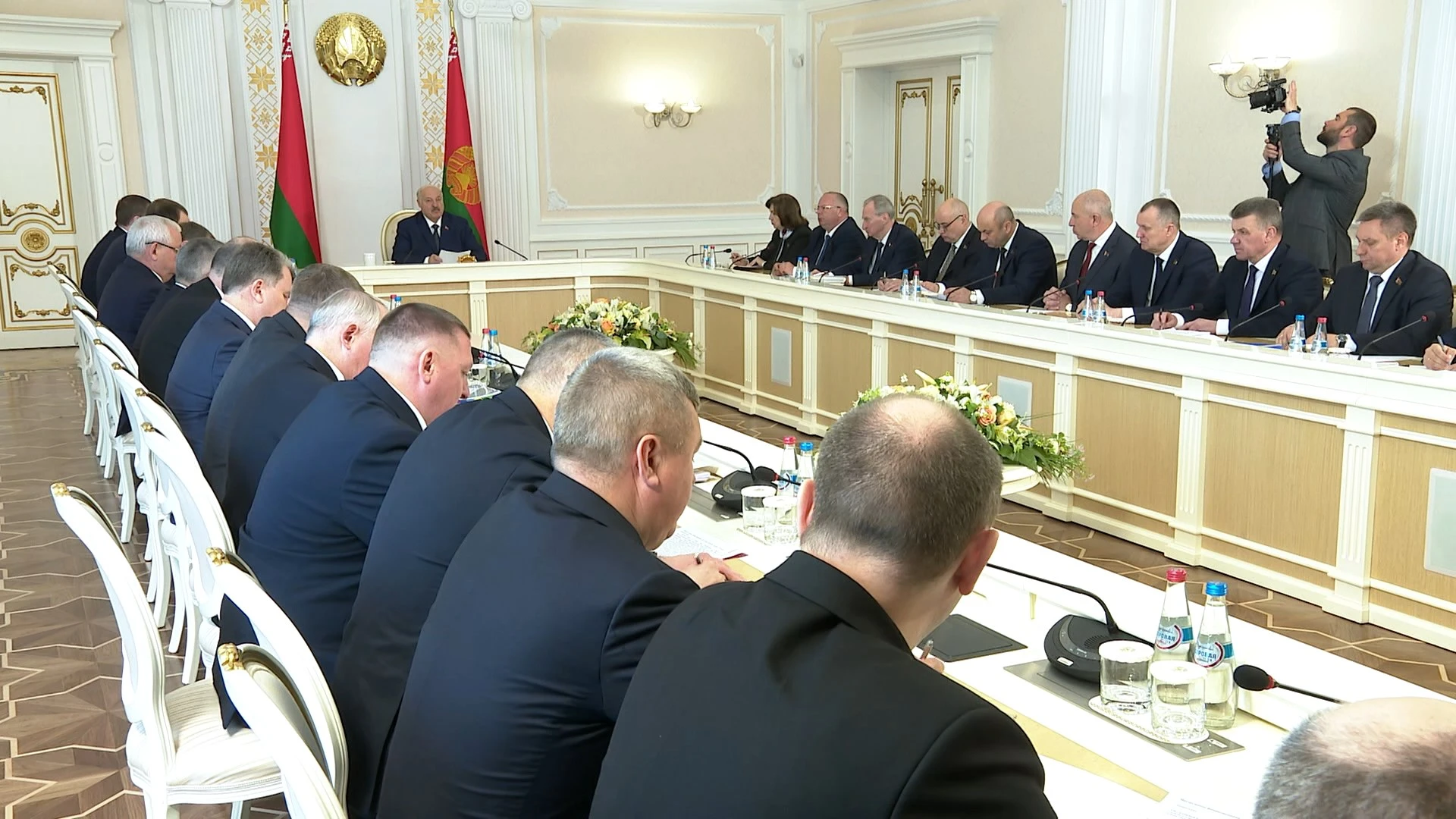
The question of how to modernise the country’s flagship regional development programme and breathe new life into it was discussed on 30 April at the Palace of Independence.
The “One District – One Project” initiative was conceived as the cornerstone of Belarusian regional policy. No matter where a district lies, it can and should create viable enterprises that generate revenue, provide dignified employment, and, around them, build infrastructure of a quality that rivals the capital itself.
The scheme has proven its worth. Yet the time has come to refine its approach: to move away from the mechanical tallying of “jobs created” toward genuinely export-oriented production; to ensure that projects arise organically from the soil, from the needs and ideas of the localities themselves, rather than being imposed from above. Of course, large-scale national programmes require firm central coordination. But what matters far more is how passionately and conscientiously those on the ground embrace them.
The theme of the meeting had first emerged during the President’s extensive working visit to the south-east of the country. On 30 April, a final discussion was held with all stakeholders. At the table sat the governors of every region, the heads of district executive committees, and directors of major enterprises. This was the concluding session before the next five-year plan: a candid review of the programme’s strengths and shortcomings.
President Alexander Lukashenko noted that many of the country’s 118 districts continue to suffer from population outflow, especially in rural areas. Sociological surveys confirm that the paramount concern for regional residents is the availability of well-paid jobs. Only then come issues of pricing, leisure, housing and utilities.
“It was precisely for this reason that, in the previous five-year period, we launched the ‘One District – One Project’ initiative, hoping it would create quality employment and decent wages,” the President said.
At the programme’s outset, he acknowledged, there had been confusion and bureaucratic inertia. There was no clear system for specialising districts according to their real potential, expertise, and, most importantly, genuine local demand. 144 projects out of 217 completed. Nevertheless, 144 projects have been realised out of 217 planned. Some 3.5 billion Belarusian rubles have been invested and 6,000 new jobs created. The President’s task, he stressed, is to view the situation with unflinching candour. There were problems: formal reporting, a lack of genuine dialogue with entrepreneurs, and cumbersome financing. Yet there were also shining examples of success.
The challenge for local authorities is to become true visionaries: to seek out technologies, talent, and opportunities that allow each district to prosper. The first and indispensable step is to defeat bureaucracy within themselves.
“I do not see that our local authorities, especially district executive chairmen, truly live this agenda, immerse themselves in it, and fight for every single job where it is truly needed,” the President remarked.
Against this backdrop, there are still too many cases in which a project promised, say, a hundred new workplaces but delivered only eighty-five, and was then formally declared unfulfilled.
“That is the very essence of rampant bureaucracy,” the Belarusian leader declared.
Agro-service centres as a model for the programme
The districts of Petrikov, Mozyr, and Kalinkovichi offer instructive examples. One promising direction is the creation of large-scale agro-service centres: modern enterprises specialising in the serious repair of agricultural machinery. Any machine-and-tractor station or farmer whose own workshops cannot handle a breakdown could turn to them. This would not replace warranty service, but would often allow problems to be solved quickly and locally rather than requiring long journeys.
“We are a machine-building nation with a highly developed agriculture. This is a vital sphere. After all, if people have nothing to wear or put on their feet, there is little point in discussing anything else,” the President observed.
During his visit to Krasnopolsky District, Alexander Lukashenko familiarised himself with advanced fish-farming complexes. He suggested that this successful model could be scaled up in other regions where conditions allow. “It is an outstanding enterprise from the standpoint of both domestic and export markets,” he said.
Another focus was the expansion of a network of district agro-service centres, a topic explored at a seminar in Mozyr. These would not only service complex equipment but also become bases for manufacturing simpler yet much-needed machinery and components.
Emphasis on full production cycles
The Krasnopol fish operation exemplifies a complete production cycle: from the hatching of roe to the final filleting of market-ready product, with nothing imported. Previously, fry were brought in from the West, raised, and only then sold as finished fish. It is precisely such self-sufficient, closed-loop production that the President demands be sought and implemented everywhere. He also sent a clear message to oversight bodies: be more accommodating wherever people genuinely wish to create.
Recalling a recent conversation with Chairman of the State Control Committee Vasily Gerasimov, the head of state emphasised the inadmissibility of overreach by inspectors. “I want to stress this to the Government, to the governors, and especially to our parliamentarians. Vasily Nikolayevich has absorbed the message. Under no circumstances may we cross any red line in our relations with our society and our people,” Alexander Lukashenko declared. “We must not squeeze our citizens, especially our managers, so tightly that they flinch at every rustle. People want to live freely in their own country.”
He acknowledged that within the Committee for State Control a certain bias has appeared that must be corrected. “It exists, perhaps not with Gerasimov himself but with some of his subordinates and others: the urge to rush in and demonstrate zeal. That kind of zeal can easily backfire,” the President warned.
Handcuffs, he said, are for those who deserve them: when law-enforcement agencies possess concrete information about an offence. “If there is no such information, one must not hammer on a person’s door with a steel-toed boot. Under no circumstances.” The central message of the meeting was clear: the programme must be thoroughly revised for the coming five-year period with a focus on projects that spring from the earth itself. The highest state officials are already working in this direction.