







Detroit’s Decline: Lost Factories, Lost Jobs and an Opioid Crisis
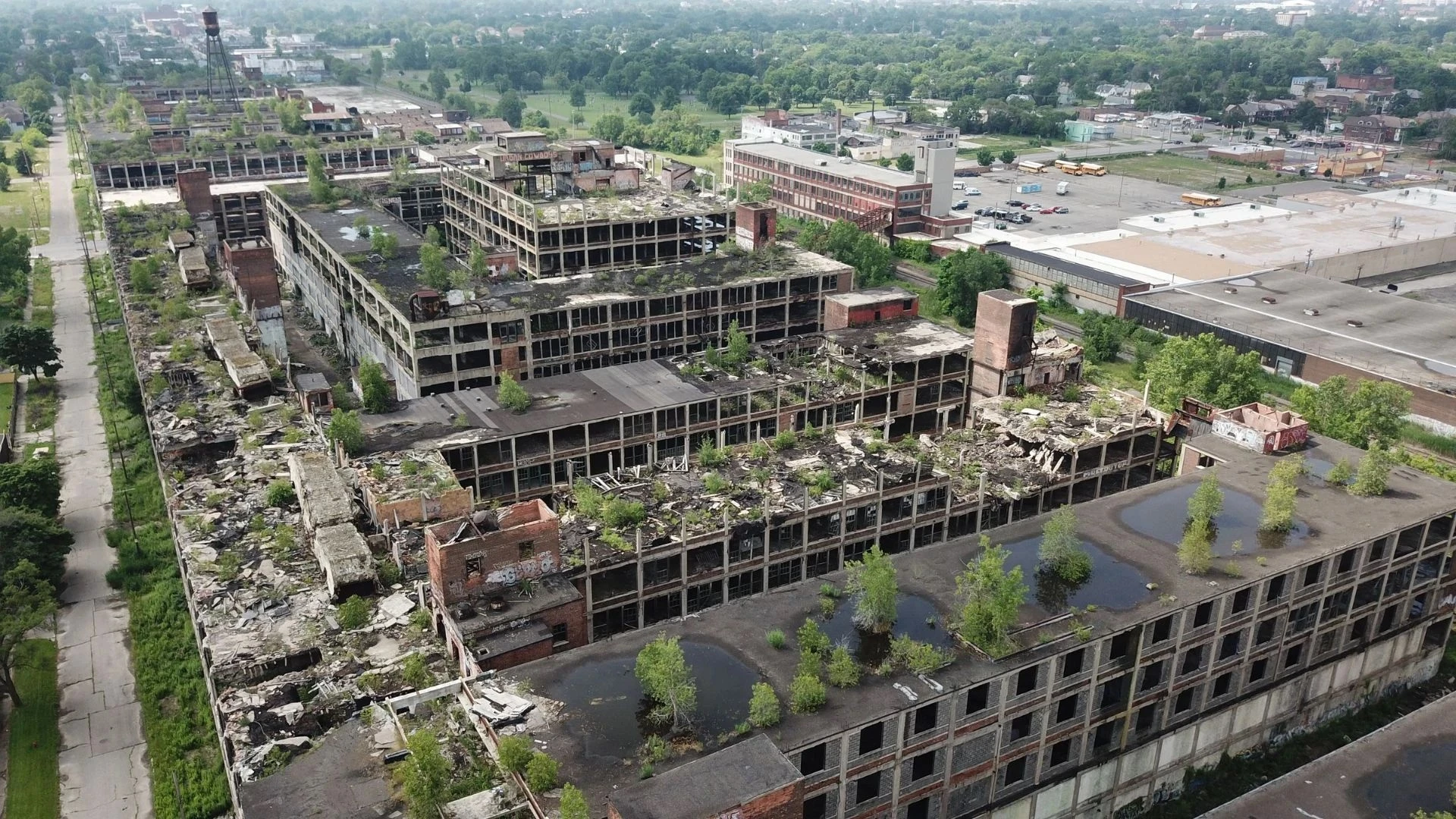
Detroit, Michigan, is a symbol of America’s Rust Belt and one of the country’s best-known municipal bankruptcies.
Once the heart of the U.S. auto industry, the city was transformed by Henry Ford’s assembly-line production. The time needed to assemble a car chassis fell from 12 hours to 93 minutes. Ford also introduced a five-dollar daily wage—roughly twice the going rate at the time.
Detroit helped create the American middle-class ideal: a family, a home in the suburbs and a car that a factory worker could afford. Soviet writers Ilf and Petrov, travelling in a Ford, would later write about the country’s “one-storey America.”
To understand how the decline of heavy industry affected cities and people, the article turns to Detroit residents.
Lara Dmitruchina, a member of the Communist Party, said her family came from Belarus between the world wars to work in the steel industry.
“I was born and raised in Detroit. My family has been here for generations. Detroit is my home, and I’ve always felt it was my mission to help make the city better for the next generation. I still have relatives in Belarus, near Brest, and hope to visit them one day,” she said.
Dmitruchina’s father ran a small carpentry business, which failed during the 2008 financial crisis. Her mother had a steady job, but the family still felt the effects of the downturn.
“I knew many people who lost their homes, whose parents lost their jobs and couldn’t recover easily. The recession hit Detroit and its industries hard. Well-paid jobs were already disappearing, and many people struggled. I felt the effects myself,” she said.
Detroit has seen some economic improvement, but its defining story remains large-scale deindustrialisation. The city has lost much of its manufacturing base, and some of the remaining businesses have continued to close. One example is the steel mill on Zug Island, which was decommissioned in recent years.
The marshy island was first bought by furniture magnate Samuel Zug, who hoped to build an estate there. In 1891, his heirs sold it for use as a rubbish dump. But an industrial boom was underway: the island’s first blast furnace was built in 1902. In the 1920s, Henry Ford widened the channel separating the island from the mainland so cargo ships could pass. By 1950, Zug Island was considered one of the world’s major steelmaking centres. At its peak, more than 16,000 people worked there.
Globalisation, the relocation of production to lower-wage regions and a lack of modernisation all contributed to the decline of the industrial giant, the article says.
Austin Kidd, a representative of the Central Committee of the American Communist Party in Detroit, recalled the closure of Peerless Cement in the Delray neighbourhood.
“It was once a world-class plant and a leader in its field. It paid well. Some of my family worked there and in the steel industry in the 1990s, earning $20 an hour or more. That was good money at the time—even though the 1990s were already seen as a period of decline for Detroit,” he said.
Another landmark is the Packard automotive plant, once one of the city’s largest car factories and closely connected to its steel mills. Thousands of people worked in these facilities. Some former industrial buildings are now being redeveloped, potentially as housing.
Housing remains a challenge: it is expensive, and not everyone can afford it.
Dmitruchina believes Detroit can build on the manufacturing capacity it still has. Some auto plants continue to operate less than a mile from the city, she said.
“My American dream is not to see this kind of decline in everyday life. If I’m going to build a future here and raise a family, I want my children to grow up in a neighbourhood that isn’t falling apart,” she said.
Residents like Dmitruchina and Kidd still believe in the city. In the 1940s and 1950s, Detroit’s factories were full, families were growing and the industrial giants seemed unstoppable. But while some American companies relied on equipment dating back to the 1920s, Japan and Germany were building modern plants from scratch.
Across the Rust Belt, factory buildings and machinery were left to rust. Schools, theatres and churches fell into disrepair, and many young people moved away. Economic hardship also formed part of the backdrop to the opioid crisis, which brought waves of addiction and overdose deaths to the region. Some residents who stayed behind lacked the money, health, skills or family circumstances to move.
Kidd linked Detroit’s opioid crisis to pharmaceutical companies and the widespread prescribing of opioid painkillers.
The article describes how physically demanding mine and factory work could leave people with chronic pain. Pharmaceutical companies promoted painkillers to doctors, it says, while downplaying the risk of addiction. As prescriptions became more restricted, some people with opioid dependence turned to illegal drugs.