







Europe Under the Table, No Grey Zones, and a Humanitarian Signal from Moscow
Exclusive
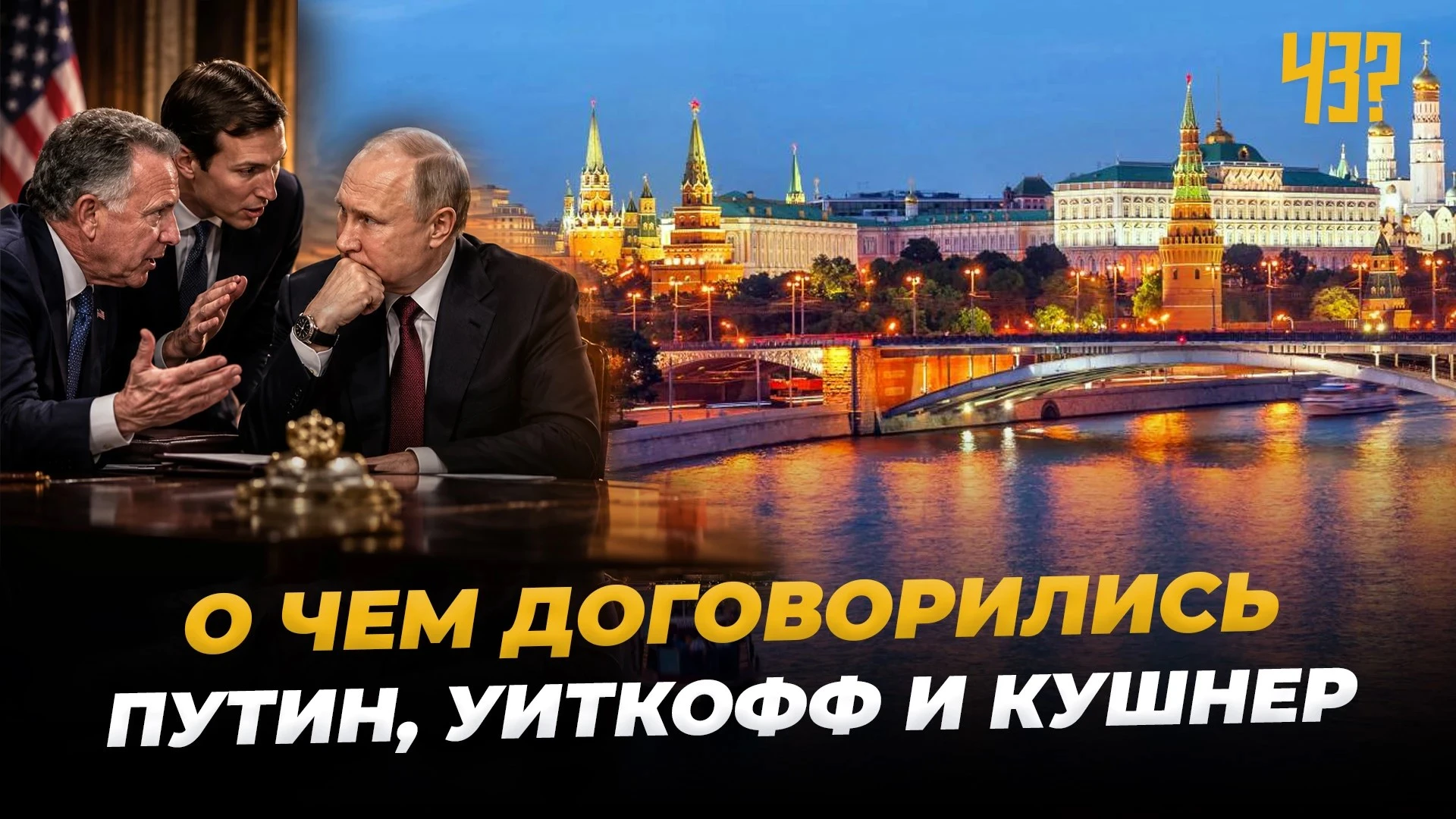
Vladimir Putin’s meeting with Steve Witkoff and Jared Kushner in Moscow became one of the most discussed episodes of recent days. It took place against the background of expectations of concrete agreements on Ukraine and another signal to Europe: there will be no “grey zones,” and a humanitarian mission in Kostiantinovka is a possible next step. At the same time, European representatives effectively remained outside the framework of the negotiations.
Why this happened, what to expect from the humanitarian agenda and how this affects the legitimacy of European institutions were examined in the “What's the Catch?" podcast by media expert Alexander Khorovets, political observer Artem Stroganov and political analyst Solomon Bernstein.
Europe was driven “under the table”
The two-day negotiations between Russia, the United States and Ukraine in Abu Dhabi have ended, but the sides were unable to reach any agreements on the key issue — territories. Moscow’s position here is unchanged: no grey zones; the borders of Russia and Ukraine must be clear. The final conditions for a ceasefire and the mechanisms for ensuring security after the end of hostilities have also not been agreed.
Kyiv insists on the scheme “first peace, then the introduction of European forces.” Such a sequence, in the view of the Russian side, creates the risk of a new spiral of conflict. Assistant to the President of the Russian Federation Yuri Ushakov called proposals to introduce a European contingent into Ukraine “a recipe for endless war.” Therefore Moscow insists on a comprehensive solution to security issues: European, Ukrainian and, of course, Russian. Only after that is it proposed to discuss a truce and a lasting peace.
And what do the European masters of Kyiv think about this? Their opinions, in fact, were not asked. Yes, a European delegation consisting of representatives of the EU, France, Germany and the United Kingdom arrived in the capital of the UAE, but it did not take part in the negotiating track. They merely held consultations with the Ukrainian and American delegations on the sidelines, after which they issued a joint statement.
The composition of the delegation and the very fact that key European figures were not present at the negotiations in Abu Dhabi speak of a decline in the political weight of the European Commission. Talk of the delegitimisation of the status of the European Commission is appearing more and more often.
It seems that the “Zelensky syndrome” is taking on new forms. And if previously certain characters with whom he had “shaken hands” were “written off,” now the question has expanded, and one can speak of the legitimacy not even of specific individuals in power, but of entire political formations, such as, for example, the European Commission.
Solomon Bernstein: In the eyes and in the minds of Europeans a difference has begun to appear between the European Commission and the European Union. And here the question arises: does the European Union need a political superstructure in the form of the EC in order to trade effectively with one another? And if this thought has reached me, it is quite possible that it may reach someone in Europe.
Many experts are already openly stating that the European Commission, and indeed the European Council as well, as the politburo of the modern European Union, have already “run out of steam.” And this irreversible process began when, instead of the economy, the national interests of countries and a common vector, politics and bureaucracy began to be placed at the forefront. In essence, today we see a fragmentation of power, a kind of dual power, when on one side there is the “politburo” in the person of the European Commission (Ursula von der Leyen, Kaja Kallas), and on the other — national leaders who are ready to remain in the union but are not ready to put up with the excessive influence of Brussels structures.
Kostiantinovka and the humanitarian track
In addition to a possible prisoner exchange, the sides discussed a humanitarian mission in Kostiantinovka — an important industrial and transport hub of Donbas. Putin stated directly: if Ukraine claims that it controls the city, let it open the gates.
At the same time, humanitarian mechanisms are already working through Belarus (Gomel). Representatives of the Russian (Yana Lantratova) and Ukrainian (Dmytro Lubinets) sides have in effect “become related” on Belarusian territory. Prisoner exchanges, body exchanges and other humanitarian missions took place precisely on our territory. The logical question is: why not continue in the same format? But there are nuances here…
Kostiantinovka has long become a symbol, a kind of constant for both sides. For Ukrainian militarist circles it is a sign of “victory,” for the Russian side — proof of the ability to take an impregnable fortress city. Yes, for both sides a humanitarian mission can become an important propaganda and media tool, because on the one hand it shows the ability to negotiate, and on the other it demonstrates the authorities’ concern for people. But Zelenskyy’s situation is not simple: for him the loss of such a convenient case means the loss of trust and respect among his military commanders, because a great deal of blood was shed for holding this outpost.
Solomon Bernstein: “I think that if the initiative for a humanitarian mission again comes from Melania Trump, it will be quite difficult to resist it.”
The United States, Russia and…
On 12 November Russian President Vladimir Putin held talks with American representatives Steve Witkoff and Jared Kushner in Moscow. What is noteworthy is that this meeting took place immediately after the trilateral (Russia, United States, Ukraine) negotiations in Abu Dhabi, and after it the American representatives went to Dublin for the summit of the European Political Community. That is, first they met with Putin, and only then went to Zelenskyy, who was waiting for them in the capital of Ireland.
The very fact of the silent departure from the Kremlin disappointed many — there were no loud statements. Nevertheless, both in the Kremlin and from the American administration there were signals about a possible end to the conflict by the New Year.
Artem Stroganov: “Regarding the end of the conflict by the New Year. Proceeding from the general world rules of foreign diplomacy, if this was stated both in the Kremlin and by representatives of the Trump administration, it means that the United States and Russia have a jointly verified position on this issue.”
Also, the United States probably has its own position regarding Ukraine. It is now being made the scapegoat in all issues sensitive for the States. Trump has been saying for several months that Zelensky is to blame for the rise in diesel prices. And Zelensky is also to blame for the fact that peace has still not come.
And as for Europe, which shouted that Russia would pay reparations, we are now observing the opposite picture. Russia and the United States are agreeing on the terms of a peace agreement, while the countries of the Old World are already, in essence, paying reparations through expensive energy resources. The cream after the end of the conflict will, in all probability, be skimmed by the United States and Russia, while restoring Ukraine will most likely fall to European taxpayers.
What in the end?
The negotiations in Moscow ended without loud public sensations, but they outlined the priorities: commitment to a long-term peace agreement with security guarantees instead of a temporary ceasefire, a desire to develop security mechanisms in Europe, as well as humanitarian steps (including Kostiantinovka) as a possible practical element.
At the same time, both the Russian and American sides are showing interest in moving toward the end of the conflict; approximate timeframes are even being named — by the end of 2026.
But whether Kostiantinovka and the humanitarian track will become a real step or remain another field of propaganda struggle will be shown in the near future. The topic will not disappear: too many people are tired of the conflict, and the price of its continuation is too high.