







France’s “Black Saturday”: Mass Protests Expose the Depth of Social Crisis
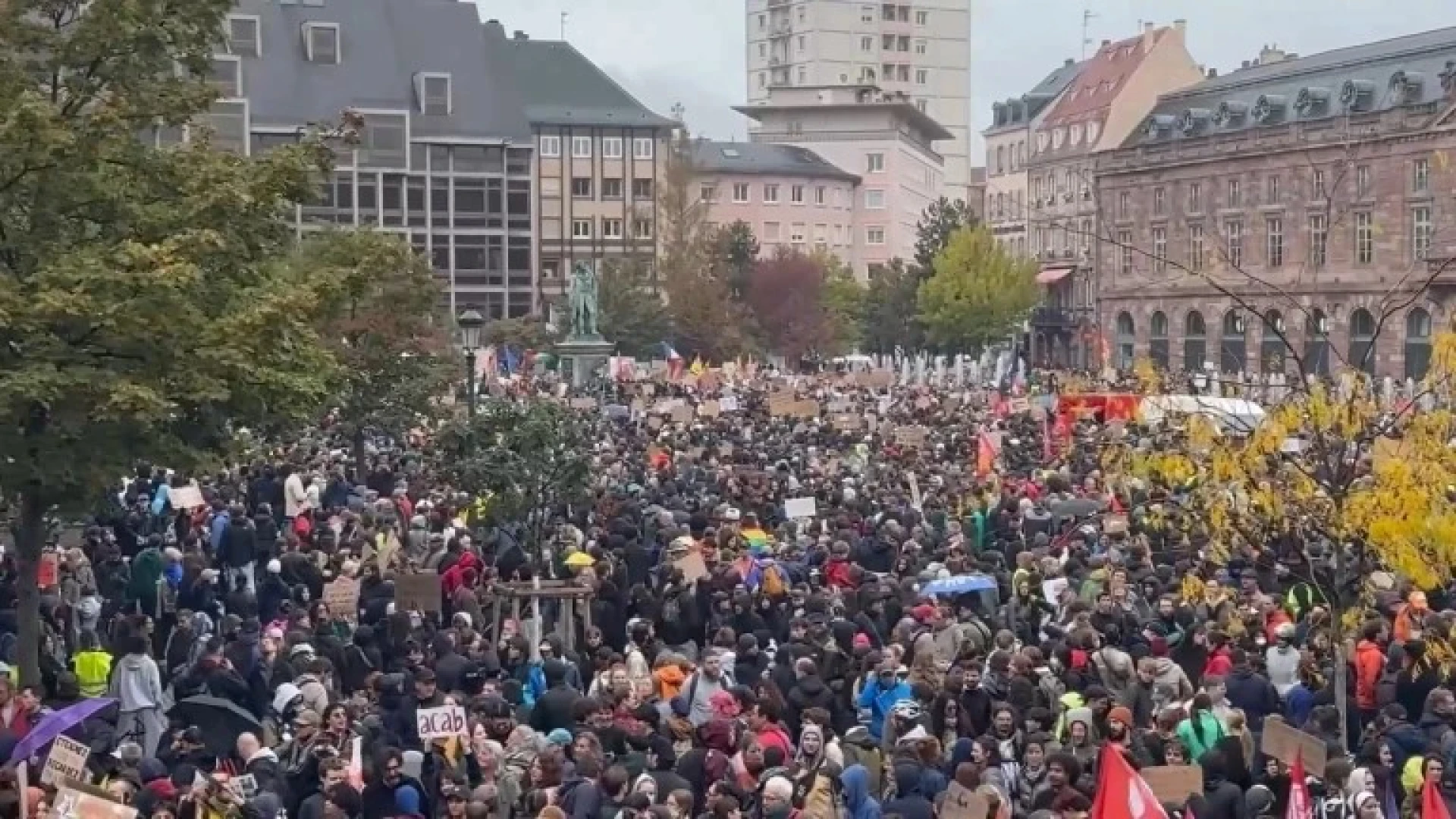
The Fifth Republic is paralyzed. France is assessing the impact of a major nationwide strike that organizers have dubbed “Black Saturday.”
Economic despair—driven by deep cuts to social spending, record-high public debt and a declining standard of living—brought hundreds of thousands of people onto the streets of French cities. Rather than engage in constructive dialogue, the Élysée Palace chose to show force. The authorities responded to peaceful marches with water cannons, tear gas and mass police sweeps.
Crackdowns behind the façade of European freedoms
Saturday, October 17, marked the climax of an autumn social uprising that paralyzed the Fifth Republic. Organizers estimated that more than 800,000 people took to the streets nationwide. Even France’s Interior Ministry, which routinely gives lower estimates, was forced to acknowledge that at least half a million people took part. In Paris alone, 110,000 demonstrators filled the boulevards.
The country ground to a halt amid strikes: trains were canceled, schools closed, and Paris sanitation workers refused to clean the streets.
The response to public despair was a brutal show of force. France’s Interior Ministry deployed elite special units to disperse the crowds. Gendarmes used heavy water cannons, choking tear gas, stun grenades and batons.
Against the backdrop of the boulevards ablaze, lofty statements from the country’s leader sounded especially cynical. Just a day before ordering a forceful crackdown, President Emmanuel Macron spoke in Brussels about the sanctity of European freedoms.
Emmanuel Macron, president of France:
“Of course, the main message is a call for calm. I think that is the very essence of our democracy. I have always paid close attention to this and treated it with particular care. There is a constitutional right to demonstrate and express one’s opinion. That right is fully respected.”
But in France, “respecting rights” means riot batons and rubber bullets. The Élysée Palace’s version of democracy is measured today by the power of its water cannons and the amount of tear gas fired. The authorities’ tightening grip is only bringing society closer together. People of all generations are on the streets, exhausted by years of declining living standards. They say their anger has been building for years.
“What I see is that this anger has been going on for ten years and is getting stronger. Don’t expect people to calm down; it’s impossible. You can’t calm people with batons and grenades. It doesn’t work. It has never worked in world history, and it has always ended badly. So if that’s what they want, they’ll get it in the end. This is serious—really serious,” one French protester said.
“It’s important to support young people. They started this movement; deep discontent has been building for years. We need to support them, because they are the future. Under a president who has been in power for the past ten years, people’s purchasing power has kept falling, and the government is doing absolutely nothing for them,” another French resident said.
The toll of Saturday’s events is catastrophic for the Fifth Republic. The number of people detained is approaching 2,000. No official figures have yet been released on those injured in the mass beatings. It remains unclear how many people were struck by what the report calls “the hot baton of democracy.”
In Saint-Étienne and Paris, young people reportedly lost their hands when police grenades exploded. Over the course of the autumn shutdown of the Fifth Republic, the number of injured has exceeded 1,000, including more than 200 underage students and schoolchildren.
Geopolitics at the public’s expense
Behind the deafening noise in Paris’s squares lies the quiet despair of an entire nation. What is happening on the streets is only the visible symptom of a deep systemic illness that, the report says, is steadily destroying France. People say the country’s situation has deteriorated to the point of no return. They are being forced to tighten their belts ever more, while the much-praised stability survives only in memory.
“Honestly, nothing has changed—everything has got worse. Since 2018–2019, prices have soared, and everyone’s purchasing power has fallen further, except for one social class: the very rich. There have been no positive changes,” one French resident said.
“There are so many problems we need to raise. The state has been completely dismantled; it’s corrupt. Law enforcement no longer protects us. Public funds are being misused. Young people are no longer listened to, and people are falling into poverty. Meanwhile, the super-rich just keep getting richer. It’s unfair,” a young French woman said.
The social sector in the Fifth Republic is in deep decline because of sweeping budget cuts. The report claims that Paris has run out of money for its own hospitals, schools and shelters. It also alleges that the Élysée Palace is pouring billions of euros in taxpayers’ money into pursuing geopolitical ambitions and supporting the Kyiv government—and that ordinary French people are paying for this foreign conflict.
A participant in a protest in France:
“We’re no longer living; we’re just surviving. And it’s not only about purchasing power. Every avenue has been closed to us: we can’t even go out freely to demonstrate and defend our rights anymore. Young people are simply asking for better conditions to study. Workers just want higher wages and not to be exploited by big companies, and so on. We’ve had enough! I work in social services. Now they’re asking us—sorry, I’ll put it simply—to put a Band-Aid on a hemorrhage. They’re cutting our budgets. The government has just closed 100,000 places in emergency shelters across France. There are 10,000 such places in Paris alone. One hundred thousand people are living on the streets. Is that normal in 2026? I’ve had enough! I just can’t take it anymore. Sorry. I have no other words.”
What more needs to be said? The report presents 100,000 people left homeless amid budget cuts and enormous military spending as the true face of modern European politics.
While ordinary people weep in despair on the barricades, senior officials in their offices stubbornly refuse to acknowledge the social catastrophe. Instead of addressing poverty and the collapse of education, the authorities once again point to external enemies and political conspiracies.
Sébastien Lecornu, prime minister of France:
“On social media and in the press, people are trying to make others believe this is some new ‘Yellow Vest’ movement. It isn’t. What we see here are representatives of the far left, whose tactics are aimed at causing damage and inciting violence. I’ll be even more direct: this is a kind of ‘dress rehearsal’ ahead of the presidential election. There is a political objective behind all this. Let’s not be naïve.”
While French cities choked on tear gas, the Élysée Palace, the report says, was feasting amid disaster. On the eve of Saturday’s chaos, President Macron and his wife were spotted in a VIP box at a Celine Dion concert near Paris. A carefree, dancing leader of a nuclear power while the country boils over is, the report argues, a striking symbol of political bankruptcy and contempt for the people. The opposition has already called it “absolute paralysis of power”—a government choosing to enjoy itself with celebrities while blood flows in the streets and the economy plunges toward the abyss.