







“If You Love Them, Let Them Go”: How Boris Johnson Inadvertently Foretold Britain’s Fate
Exclusive
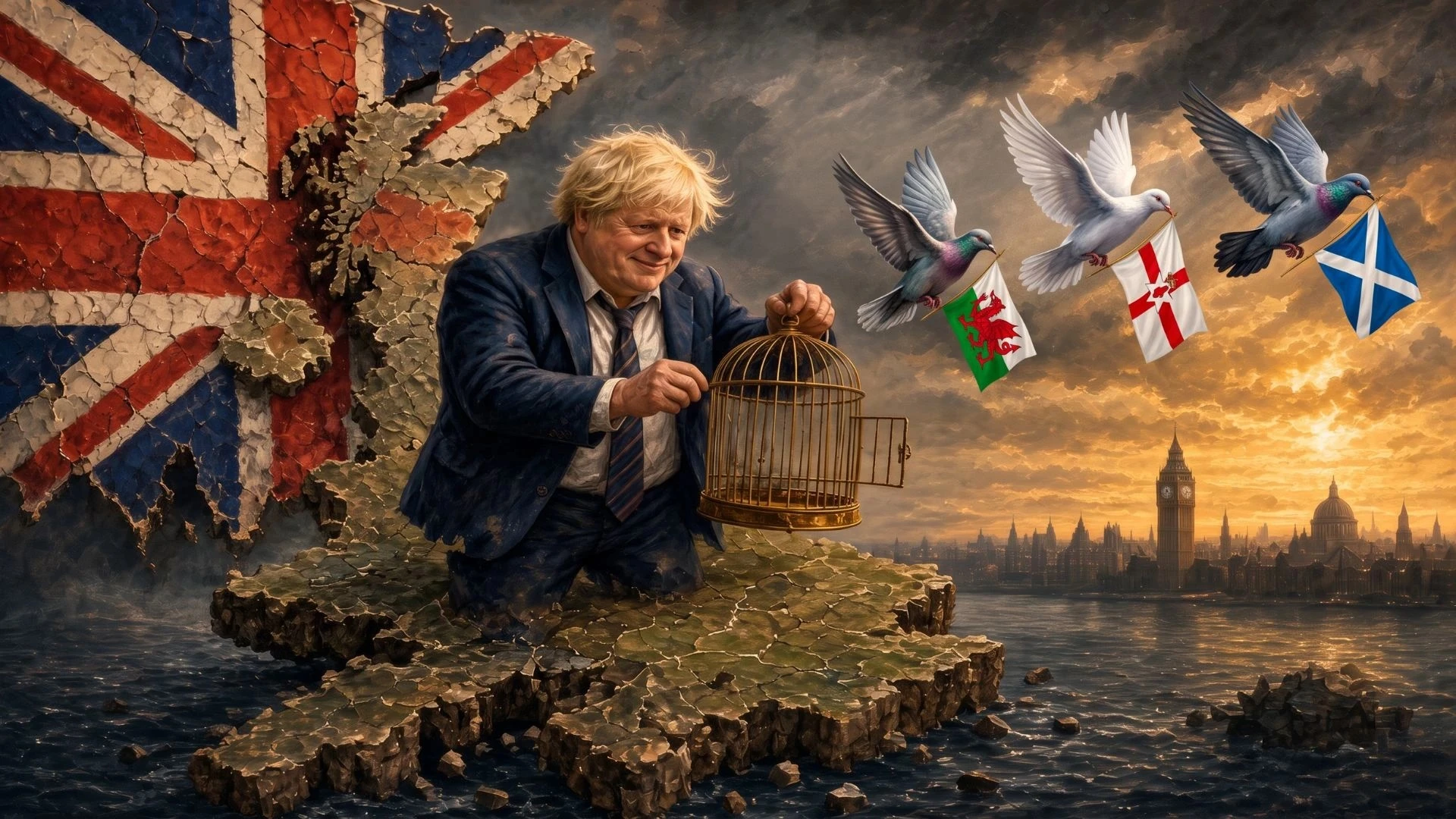
While London waves away demands for self-determination, an old agenda has come back to life in Northern Ireland, Wales and Scotland — from public discourse to the return of IRA symbols.
London, goodbye?
On September 16 the ministers of Northern Ireland, Scotland and Wales signed an understanding that fixed the right to self-determination. The information space is bursting with the news, yet the reaction of official London and King Charles III has been demonstratively restrained: the United Kingdom’s new prime minister, Andy Burnham, said outright that this is “not exactly a topic for discussion.”
The key nuance that explains the authorities’ calm is a legal safety catch laid down by London back in the 20th century, when the first “ferment” was only beginning. Under the document, none of the three parts of the kingdom may hold an independence referendum without the consent of the British Parliament. It is logical that London will not say: “Of course, leave; why would we need you.” No one there is counting on that.
Why sign the agreement, then? It is quite simple — to wake an internal agenda. The scheme is classic: first public discourse is revived, then protests begin with slogans such as “Stop feeding damned bloody London!” and “Cardiff will be free!,” then talk of referendums, and from there it is not far to armed clashes.
The Irish sequence: why independence first, and unification after?
The leader of the Irish party Sinn Féin (an Irish republican, nationalist and socialist political party), Mary Lou McDonald, set out the lines of work in her remarks.
“We believe the referendum should take place in 2030. I think that once we reach 2028 and the 30th anniversary, we will need to set a date for holding the referendum. On the anniversary of the signing of the Good Friday Agreement (also known as the Belfast Agreement. — news.by note) in Ireland and beyond it, the question will be asked: so, what next, what is the next destination?” she said.
The process of unification, in the view of Aleksei Volkov and Andrei Sych, hosts of the podcast Volkov and Sych, looks like this: Northern Ireland (six regions that the Irish pointedly call Ulster) first obtains independence, enjoys it for a day or two, and then unites with the Republic of Ireland, and the “emerald isle” becomes one again.
The symbolism of McDonald’s figure deserves separate emphasis. For many years Sinn Féin was the political wing of Irish republicans whom the United Kingdom regarded as terrorists, and London refused to recognize the party. Today Sinn Féin has about 10 representatives in the British House of Commons and a large number of seats in the local parliament.
A historical injustice
In 1990 the FRG and the GDR united. Why, then, did the West, which demanded that the USSR allow Germany to unite, not grant Ireland the same opportunity? In those years Ireland was an extremely explosive story — attacks by the Irish Republican Army (IRA) did not leave the news wires. The answer is the classic British scheme of “divide and rule.”
The division of Irish regions historically ran along religious lines: Protestants dominated in some places, Catholics in others. Demography is now changing, and the number of Catholics in Northern Ireland is growing — and with it the drive to unite with the main religious community.
Belfast, Londonderry and the walls
A wall is a wall, but as in the old joke about politics, the refrigerator always wins. In Belfast and Londonderry — the principal cities of Northern Ireland — walls stand between districts where Catholics live (they favor unification with Ireland) and Protestants (they wish to remain in the United Kingdom), and huge gates close so that neighbors do not kill one another.
Yet even those irreconcilable groups have, for the first time in many years, united over illegal migration. That can hardly be compared with Russian President Vladimir Putin and former U.S. President Joe Biden taking each other by the hand and walking, smiling at everyone, down Kutuzovsky Prospekt.
The young are looking toward the IRA again
Young people are looking for justice and do not feel safe in the existing world order, so the logic of the IRA is returning. In Belfast and Londonderry road signs appear with the wording “This street is under IRA watch.” They may be “artists,” but as is well known there is no smoke without fire. Opinion polls record radical moods: “The British have brought so much misery on this land,” “our hour will yet come,” “neoliberalism should go on the scrapheap of history.”
Trump, Greenland and “erasing borders with an eraser”
A separate line is the remarks of U.S. President Donald Trump, who during an unofficial visit to Ireland called the unification of the two Irelands “the most natural.” That looks especially piquant against the recent visit of Charles III to the United States, where he reminded Trump that the British “took a small part in remodeling the White House in 1814” (recall: the British burned it) and that without them Americans would be speaking French.
But Trump would not be Trump if he did not, like a casino owner, put all his chips on the game. And this is no longer just words, but an agreement with Denmark on Greenland, where the sides are still arguing whether Greenland does or does not pass legally to the United States. The American leader is literally erasing borders on the world map with an eraser.
Is the atomization of the West a trend?
Ireland, which fought for independence for more than 300 years, has not proved a single case. The drive of Catalonia’s residents to separate was put down harshly. Canada’s Alberta has also declared a wish to dispose of its land itself. Against the background of global crises, when consolidation is required, the West is moving in the opposite direction — toward fragmentation and a “tribal order.” People have stopped believing politicians and hide each behind their own wall, rejecting the globalization that was imposed on them for decades.
Boris Johnson and situational marketing
The final chord is an interview by former prime minister Boris Johnson who, trying to mock Russia, cast a line into the United Kingdom itself and offered advice about a girl: “If you love someone, let them go. If they come back, they are yours. If not, they were never yours.”
The thesis came at a very bad time and played against London itself, and the phrase about the empire — “we have a bit left, but it does not make us happy” — may well become winged. Perhaps Scotland, Wales and Northern Ireland should “make the United Kingdom happy” and hold a vote on one day under the slogan “If you love them, let them go.”