







Millions in the Himalayas Face Glacial Flood Risk in Coming Years
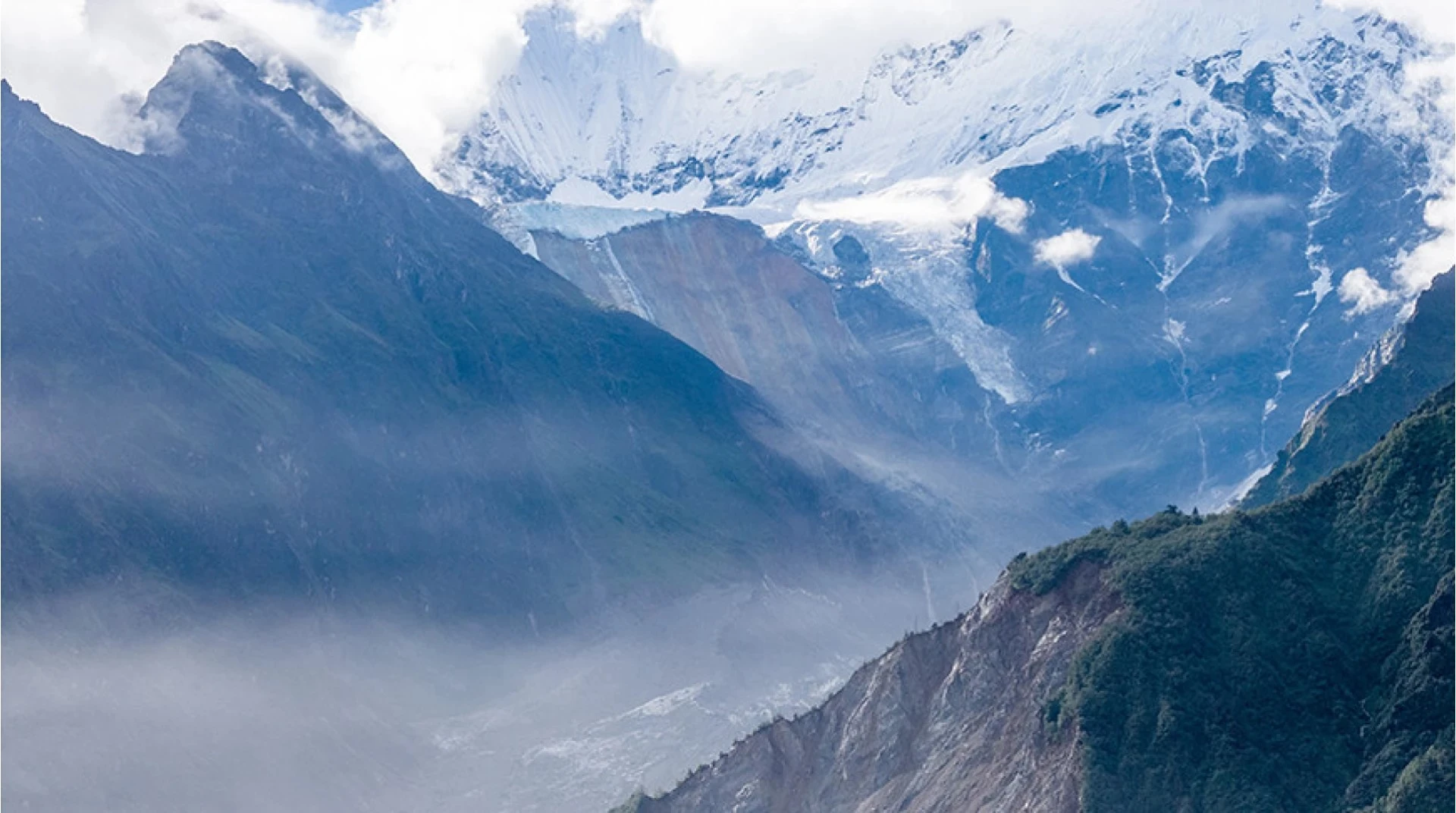
In the coming years millions of inhabitants of the Himalayan region will face a catastrophic risk of glacial floods. With such an official statement Assistant Secretary-General of the UN Kanni Wignaraja came forward. The pretext for the emergency warning was a recent destructive collapse of a glacier in Nepal that occurred at the end of August 2026 and took the lives of more than 1,000 people, BELTA reports.
Under threat is not only hydropower, on which many depend, but entire banks of rivers where millions of people live may become in fact unfit for life. “Technologies are not developing fast enough to prevent losses along these large-scale river systems that collect the surpluses of glacial lakes,” Kanni Wignaraja stated.
In 2020 researchers identified 47 potentially dangerous glacial lakes in Nepal, China, and India. Since then it has been established that the real number of such lakes is significantly higher. “The number of the population located in the zone of risk is counted in millions,” Wignaraja stated.
The destructive flood in Nepal was caused by the collapse of parts of a glacier near the summit of Mount Langtang Lirung, which led to a landslide and a flood. A breach of glacial lakes occurs when melting glacial water accumulates behind a natural barrier, and pressure in the end leads to a rupture or overflow, causing a sudden flood downstream. Threats intensify as climate change accelerates the melting of glaciers in the region, loosening mountain rock and exerting greater pressure on the barriers of glacial lakes.
According to Wignaraja, the mountains of this region are also relatively young and therefore more subject to tectonic shifts, which may also provoke sudden collapses of glaciers or lake barriers. The representative of the UN stated that not a single country in the region depends on glaciers to a greater degree both in the plan of water supply and in the plan of incomes than Nepal, which now faces a “very, very complex choice.” For many who live along rivers, a move to higher ground may prove financially unprofitable.
Critically important infrastructure will also remain vulnerable. Losses in the electric-power industry of Nepal may be more serious than some estimates indicate. In the UN they reported that the flood put out of action 15 large electric-power stations, besides those operating.
Prime Minister of Nepal Balendra Shah named climate change as the main cause of the destructive flood in the republic, TASS reports. “It is proven that because of climate change the temperature in the Himalayan region has risen by 1.8 degrees, therefore there is no doubt that precisely this became the cause of the catastrophe. Climate change is a global problem, and reaction to the disasters caused by it is the common responsibility of the entire world,” he wrote on Facebook.
As the premier indicated, “in the opinion of experts with whom consultations were conducted, the flood on the Bhote Koshi River in Rasuwa District became the largest disaster in the Himalayan region caused by the descent of a snow-and-rock avalanche.”
“This incident visually demonstrated that the risks we face in the Himalayan region grow as the climate changes. Therefore the time has come not only to raise awareness inside the region itself but also decisively to state to the international community the catastrophic consequences of climate change with which we are dealing,” Shah added.
According to him, “as a result of the melting of ice inside the glacier in its collapse ice and water could mix.” “In the opinion of experts, the collapse of a significant part of the glacier from a great height gave the flow colossal energy. At the place of fall the mass began to melt, and this process continued, growing into a powerful flood. Descending from Himalayan heights toward Nepal, the flow gathered still greater force and devastated the locality,” he noted.
Deputy head of the State Climate Center of the PRC Gao Rong stated that natural disasters in the district of Tibet threaten to become more frequent and to take larger scales because of global warming. “In the near future the stability of the internal structure of glaciers of the Tibetan Plateau will decline. Disasters caused by glaciers may become more frequent, and a series of cataclysms is capable of leading to an increase of the scales of destruction, of influencing the zone of their spread,” he reported.
As the deputy head of the climate center specified, over the last 60 years the area of glaciers on the Tibetan Plateau has contracted by about a quarter, including 7,000 small glaciers that have completely disappeared. According to him, in connection with global warming the process of melting has accelerated.
On 26 August in the north of Nepal a powerful flood arose, the cause of which was the descent of an avalanche on the border with China. A flow of mountain rock at enormous speed covered along the riverbed more than 70 km, destroying nearby populated points and causing the flooding of a large territory. By the latest data, as a result more than 1,100 people died. In the Chinese county of Gyirong (Tibet Autonomous Region, west of the country) a landslide took the lives of at least 16 people; another 546 are listed as missing.