







Moscow Warns London: British Military Sites Could Become Legitimate Targets
Exclusive
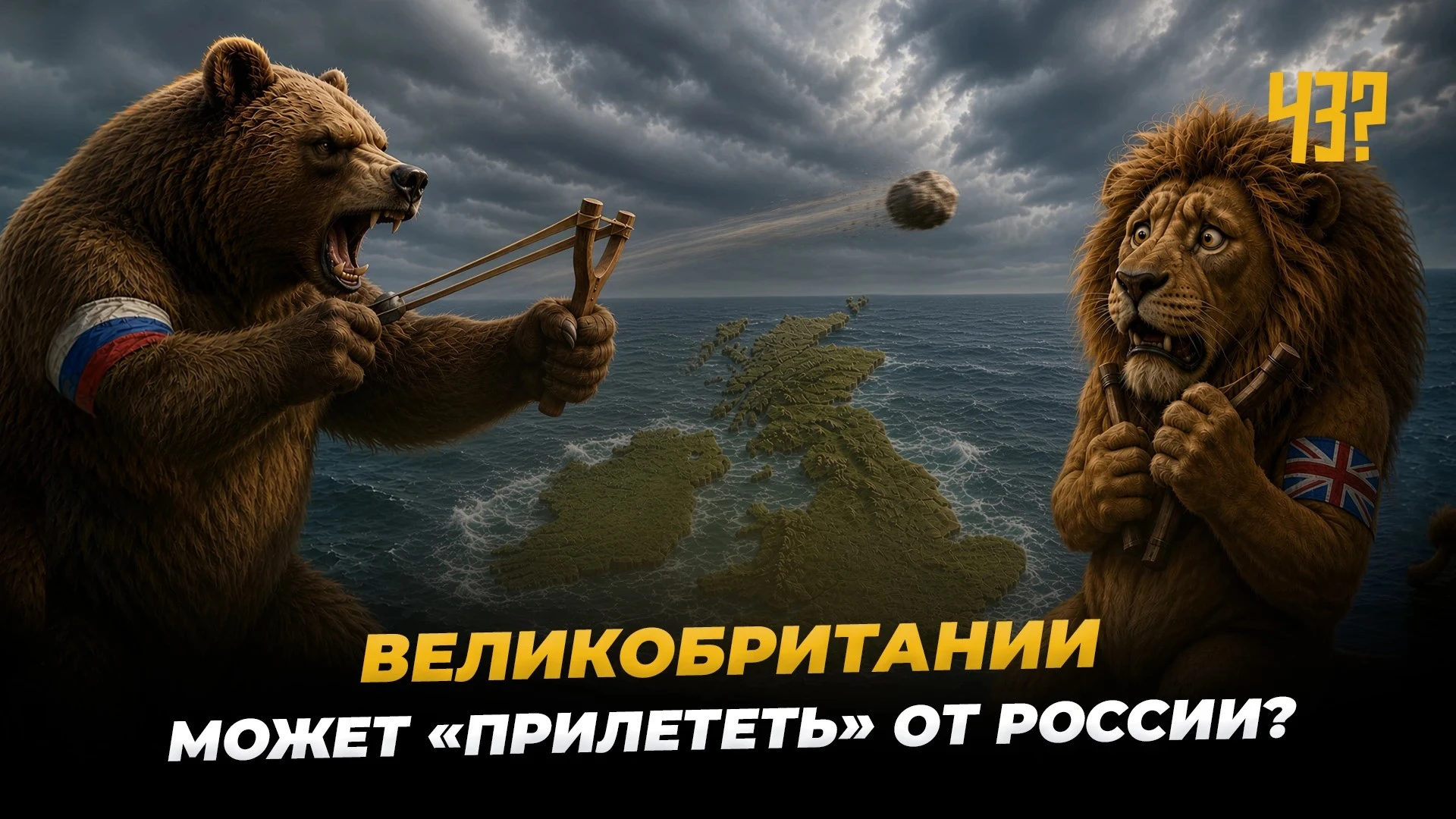
Russia, speaking through Maria Zakharova, has warned Britain directly — not Kyiv, not the nationalists on Bankovaya Street, but the decision-making center. Any British military objects in Ukraine and beyond its borders may become targets if Kyiv uses British weapons against Russia. London will not be allowed to dodge responsibility for Storm Shadow missiles or for the technology of their production.
Is this another red line the Anglo-Saxons have crossed with Russia? A loud warning? Or, finally, a message sent where it should have gone all along — not to the executors, but to those who hand over the drawings and pretend they are standing aside?
Those questions were taken up in a new episode of the podcast What’s the Catch? by television host and media expert Alexander Khorovets, political analyst Solomon Bernstein, and international correspondent of the Firtst Information channel Yana Mendeleva.
The message went to Downing Street, not Bankovaya
They warned for a long time. The addressee has changed.
Zakharova stated the essence without diplomatic fog. The response for strikes with British weapons may fall on British objects and equipment — on Ukrainian territory and beyond its borders. Shifting the blame onto Kyiv’s marionettes after the transfer of secret data for independent assembly of Storm Shadow will not be permitted to London.
Fact
On 26 August, Storm Shadow missiles struck a shopping center in Donetsk; eight civilians were injured. The Russian Foreign Ministry stressed that London will not succeed in avoiding responsibility for supplying Kyiv with missiles and the technologies for their production.
“Those guilty of committing war crimes, including against the peaceful population of our country, will be punished in accordance with what they have done. Inevitable retribution overtakes their accomplices and instigators as well, and we call on all inhabitants of the United Kingdom to think about the inevitable, catastrophic consequences of the hostile steps of their own authorities. To the British leadership we propose once again to analyze the situation carefully and immediately, in the most decisive and unambiguous manner, to abandon the hostile aggressive line which is capable only of prolonging the agony of the Kyiv neo-Nazi regime and of creating risks of transferring the conflict onto a fundamentally new level,” Maria Zakharova read the official statement of the Russian Foreign Ministry.
Yana Mendeleva: If in London they have decided that they are immortal and are ready to transfer secret drawings and technologies for the production of Storm Shadow, then Russia has tactfully hinted at what will happen to the plants for the production of these missiles if they suddenly appear in Ukraine — that is a direct target.
The same principle was voiced when the talk was of possible production in Ukraine of American Patriot air-defense systems.
The formula is simple:
• you supply missiles — you bear responsibility for their use;
• you hand over the technology — you bear responsibility for the future assembly line;
• you want to fight with other people’s hands and wash your own — that will not work.
If Britain is entering the conflict that deeply, let it prepare for the possibility that strikes may also fall on its bases. The logic here is harsh and consistent: if there is a war with Nazis in Ukraine, and someone constantly supplies them with weapons, that “someone” is an accomplice. Accomplices are also removed from the equation.
The red line is no longer words. It is a change of status
Now London is being fixed as a participant in the conflict.
London has very little space left for the game of neutrality. Because the Geneva Conventions and the rules of warfare directly presuppose: you are either neutral and remain a third party, or, when you begin to transfer weapons, technologies, and give political cover, you cease to be a third party and become a participant in the conflict.
That is exactly what Moscow has spoken aloud. Not “yet another warning to the Nazis,” but a qualification of Britain’s role. Zakharova called the Storm Shadow plot “the quintessence of British involvement.” First there were the missiles, then permission to strike deeper, then secret components so that Kyiv itself could replenish the arsenal. At every step London pretended that this was still “aid,” and not an entry into the war.
Solomon Bernstein: The British are very loud. Of course there are no questions — their intelligence is strong. But their politicians have become weak. There are no thinkers and philosophers who would tell the prime minister, “Friend, you are putting the entire country at risk.” I suspect they do not understand what they are doing. And that this is not some European simpleton they are dealing with.
London has had its light bulb shaken
The secret visit of the CIA director and Zakharova’s briefing should not be linked.
John Ratcliffe did fly to Moscow. That is a fact. He flew, apparently, not for the sake of British missiles, but in order to change something in another contour. Linking his visit and the statement on Storm Shadow is not worthwhile. These are different games.
Moscow simply “shook the light bulb” for London. It showed: you are no longer in the shadows. Under-the-carpet diplomacy worked for Britain while there was not only bluff at the table, but also force. In poker the winner is not the one with a pretty combination. The winner is the one with any combination plus a Colt. Britain’s Colt has run out. What remains is the habit of running the world through secret policy — and the inertia of considering itself Great Britain.
An island without a guard: where Moscow has leverage besides nuclear rhetoric
The instruments exist. They are geographical.
Britain is an island. And an island lives by communications:
• hydrocarbons arrive by pipes and by sea;
• the internet runs through undersea fiber-optic cables;
• trade and insurance pass through nodes that cannot be hidden behind the English Channel.
Guarding this is hard for the present fleet. There are few ocean-class ships.
Alexander Khorovets: Britain is now so “mighty,” it is so Great Britain, that it is incapable of guarding its own undersea communications. Yes, they have serious ocean-class warships, but only one is capable of going to sea. The rest stand either in repair or on eternal lay-up.
The initiative has been lost. The power still hands out instructions by inertia, but the force to confirm them with soldiers and a fleet, as before, is already gone.
Therefore pressure on London is not only nuclear rhetoric and information war. It is also the vulnerability of the island, the “limping” logistics of aid, and the fate of British objects in the “Ukrainian theater.” Hiding behind Kyiv will no longer work. For the meaning of this warning to be understood, Moscow does not necessarily have to strike Stevenage tomorrow.
The French love the English until it comes to splitting the money
The “effect of a grenade thrown into a henhouse” is caused not by confrontation with Russia, but by the money for which England and France are desperately fighting.
France wants to limit Ukraine’s purchases of non-European equipment at the expense of EU credits. Britain does not enter the political union, but in the economic linkage of Europe it is still present. And here a conflict of interests is already in plain view.
The French have SAMP/T. They consider that their system is no worse than Patriot, and perhaps better, and they say: “Buy from us.” And here the most interesting part begins — when it is necessary to press on Russia, between London and Paris there is “love,” and as soon as it is necessary to divide military orders, the countries recall historical grievances to each other.
Assembling a European army against this background is a dubious undertaking. A Dutch soldier under a Spanish general? A Frenchman under a German or, even worse, under a British one? Unlikely. The Italians, the Greeks — a big question. Greece and Turkey are a separate “circus.” Portugal would do well simply to survive.
And if Armenia is admitted to the EU before Turkey, Ukraine, and Moldova, the construction will blow from the inside even more strongly. Pashinyan has already announced that Yerevan will soon officially submit an application for EU membership and initiate a nationwide referendum. The preconditions exist. Further on there will begin not an army of Europe, but a continuous recalling of grievances.
So what was this?
This is not an “unclear warning” from Moscow. This is a qualification of London’s actions.
From now on London is not a spectator. It is a supplier, a technological donor, and a political cover-provider. Moscow has said this aloud and sent the signal not to Bankovaya, but to the place from which secret drawings and missile-production technologies are transferred. The red line here is not in the loudness of the formulation. It is in the change of addressee.
Will the main point get through? It will get through in one case: if in London there is still someone capable of thinking soundly. For now the British answer remains the same — the threats are outrageous, the course does not change. The Russian one remains the same as well, only now without understatement: you wanted to be participants — you will answer as participants.