







What’s the Catch? The world stands on the brink of a fuel crisis — $150 a barrel is almost a reality
Exclusive
September 18, 2026
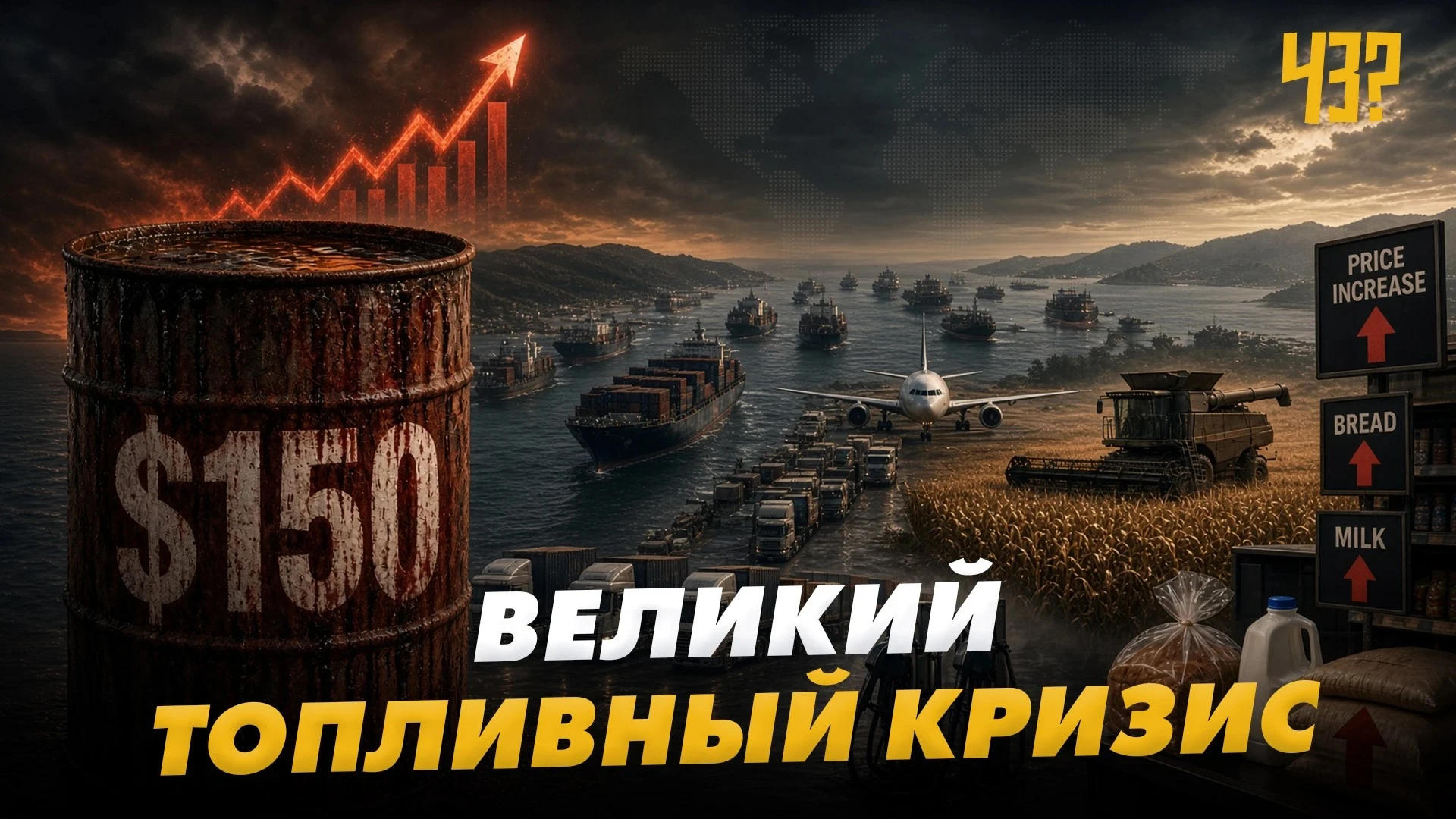
The price of a barrel of Brent crude is already holding firmly above $100, and in September this year it edged toward $109–110. Forecasts that oil will soon cost $150 a barrel no longer look like shock content; they look like a working scenario for the markets.
This is not only about prices at the pump. It is a systemic fuel shock: logistics, agriculture and aviation will take the blow — and, as a consequence, food prices will climb fast.
What awaits us in the near term? Will there be a global fuel crisis? And if so, which countries will suffer first? Those questions were answered in the podcast What’s the Catch? by media expert Alexander Khorovets, political analyst Solomon Bernstein and international correspondent of the First Information channel Yana Mendeleva.
For context
In the United States passenger cars run mainly on gasoline. Diesel there belongs to trucks, the army, farmers and the entire supply chain. That is why American commentators, when they want to soften the picture, more often talk about gasoline.
Speaking of gas prices, U.S. economists, politicians or bloggers most often measure the direct load on the ordinary consumer’s — and voter’s — wallet. Diesel prices, however, far more accurately reflect the real state of the economy, inflation and hidden costs. So while the media report that “gasoline prices have stabilized,” the economic reality can be much harsher if, at the same time, diesel is hitting records.
The cost of diesel in the United States is a hidden tax on every sphere of life. A rise in that fuel immediately pulls up the cost of harvest machinery, line-haul trucks and military logistics. For farmers it is especially painful in harvest season. The chain is simple: more expensive field work → more expensive grain and corn → a more expensive grocery basket.
Under those conditions, this Christmas promises to be one of the most expensive for people in Western countries.
Solomon Bernstein: A global fuel crisis will happen without fail, because three things can be watched forever: Trump extracting money through exchange rates and insider trading, the Baltics trying to split their own heads open, and oil trying to fall below $95 a barrel.
Not just a crisis — a “matryoshka crisis”
Speaking of a global fuel crisis, one cannot name a single main cause. Several circuits stack at once — a kind of nesting doll.
The first circuit is a burning Middle East and two straits. The Strait of Hormuz and the Bab el-Mandeb are the narrow throats of world trade in oil and goods. The Bab el-Mandeb joins the Red Sea to the Arabian Sea and is the southern approach to the Suez Canal, through which historically about 30 percent of world seaborne trade has passed. In theory Iran can close both passages at once. Then ships would have to go around Africa — an extra seven days at about 11 knots, plus transit through stretches that are, let us put it this way, risky for shipping. The costs and the risks are colossal.
On September 11 the Houthis took the strategic port city of Mocha, Perim Island (Mayyun) in the Bab el-Mandeb itself, and a number of islands in the southern Red Sea. They now fully control the coast.
Solomon Bernstein: In essence the Houthis can turn the Red Sea into a lake. That is, water will still move on it — ships will not, because it is under fire.
At the same time a difficult situation persists in the Strait of Hormuz. That, too, should not be forgotten.
The second circuit is Europe’s already existing rupture with Russian energy and its replacement by American supplies. In 2025 Ursula von der Leyen signed a binding deal with the United States under which the EU undertakes, by 2028, to buy $750 billion worth of energy from the United States. The aim is to ensure Europe’s energy security, diversify sources and substitute the Russian energy that used to be supplied.
Besides energy, the deal includes European purchases of U.S. AI chips for data centers (at least another $40 billion) and preferential terms for U.S. agricultural and fishery products.
For Russia that “arrangement” meant its share of the European energy market falling to a historic low (imports of Russian gas now stand at about 16 percent, though they were once around 44 percent). The U.S. share, by contrast, has risen to a maximum (almost 56 percent).
Has that made things better for Europe? Instead of an answer, two figures. A few years ago, when Russia sold gas to EU countries at $160 per thousand cubic meters, Brussels called it “the Kremlin’s energy blackmail” and “an attempt to use energy as a diplomatic ram.” Today exchange prices for gas in Europe exceed $1,000 per cubic meter. And Europeans pay — quietly and obediently.
The third circuit is the quality of oil and the geography of production. Yes, the United States has obtained long-term access to Venezuelan fields with reserves of about 65 billion barrels. But there is a catch. This is mainly extra-heavy crude of the Orinoco Belt: it lies deep, often in hard-to-reach terrain, and barely flows on its own. To pump it and send it through pipes, diluents are needed. In plain terms, you cannot dig it out with a shovel, and you cannot put it on the market overnight.
On top of that, Washington is rapidly losing a once stable and predictable economic rear-area partner. A flaring trade war between the United States and Canada is forcing Ottawa to change priorities. It has sharply increased merchandise exports to China (more than $15.6 billion) and in September also imposed mirror tariffs (from 15 to 50 percent) on about $20 billion of U.S. goods.
Yana Mendeleva: For Trump, who unleashed the conflict in the Middle East and is not managing to finish it, this entire oil crisis does not play into his hands. Plus Ukraine — he thought they would sort it out there very quickly. But we see that there is still no peaceful settlement of the conflict.
Who will hurt most
In the European Union, despite the geographic distance from Yemen and the Persian Gulf, the blow is already being felt. A shortage of jet fuel, idle refineries, expensive gas and dependence on sea routes through Suez hit industry and transport faster than they hit countries with their own production. The next logical step is the risk of recession.
India is vulnerable because of a high share of oil imports (about 85 percent). At $150 a barrel the load on the balance of payments and on domestic prices becomes extremely severe. In the same row stand the Philippines and Vietnam.
China looks different in this scenario. Expensive feedstock is no gift to it either, but Beijing can accelerate its link with Russia, in particular through the Power of Siberia 2 pipeline project, and turn itself into a hub for Russian energy toward the Far East and Southeast Asia. Then, instead of passively absorbing a price shock, Beijing would gain the ability to manage energy flows, redirecting them to other countries.
Alexander Khorovets: This entire energy crisis, as I see it, was modeled — I am not afraid of the word — by the genius of Trump. It was created artificially, through the bombing of Iran, so that the United States could bend China. That is my assumption.
The United States itself produces light crude and is formally less dependent on gasoline “from someone else’s market.” The psychological mark for the American economy is $95 a barrel: below that, oil “stubbornly refuses” to fall, and when the price is higher, logistics costs start to rise and food becomes more expensive. At the same time Washington has already taken Russia’s place in a substantial part of the European market.
On the other hand, Trump himself has become a hostage of unfinished conflicts — in the Middle East and around Ukraine. He would like to come out of the whole situation as a champion, but expensive oil hits the United States as well. And the question arises: will the American construction itself withstand the rise in diesel prices, insurance, freight and secondary sanctions on parallel imports?
The conclusion so far is one. This is not a story about “gasoline that got more expensive at the pump.” It is a linkage of sea lanes, tankers, diesel, food and political deals. As long as the Bab el-Mandeb and Hormuz remain under fire, and Europe buys American LNG at a steep premium, the heaviest bill will go to countries with high import dependence and a thin food margin — Europe already, India and part of Southeast Asia after it.