







Why Globalist Analytics Has Degenerated into Simple Charlatanism
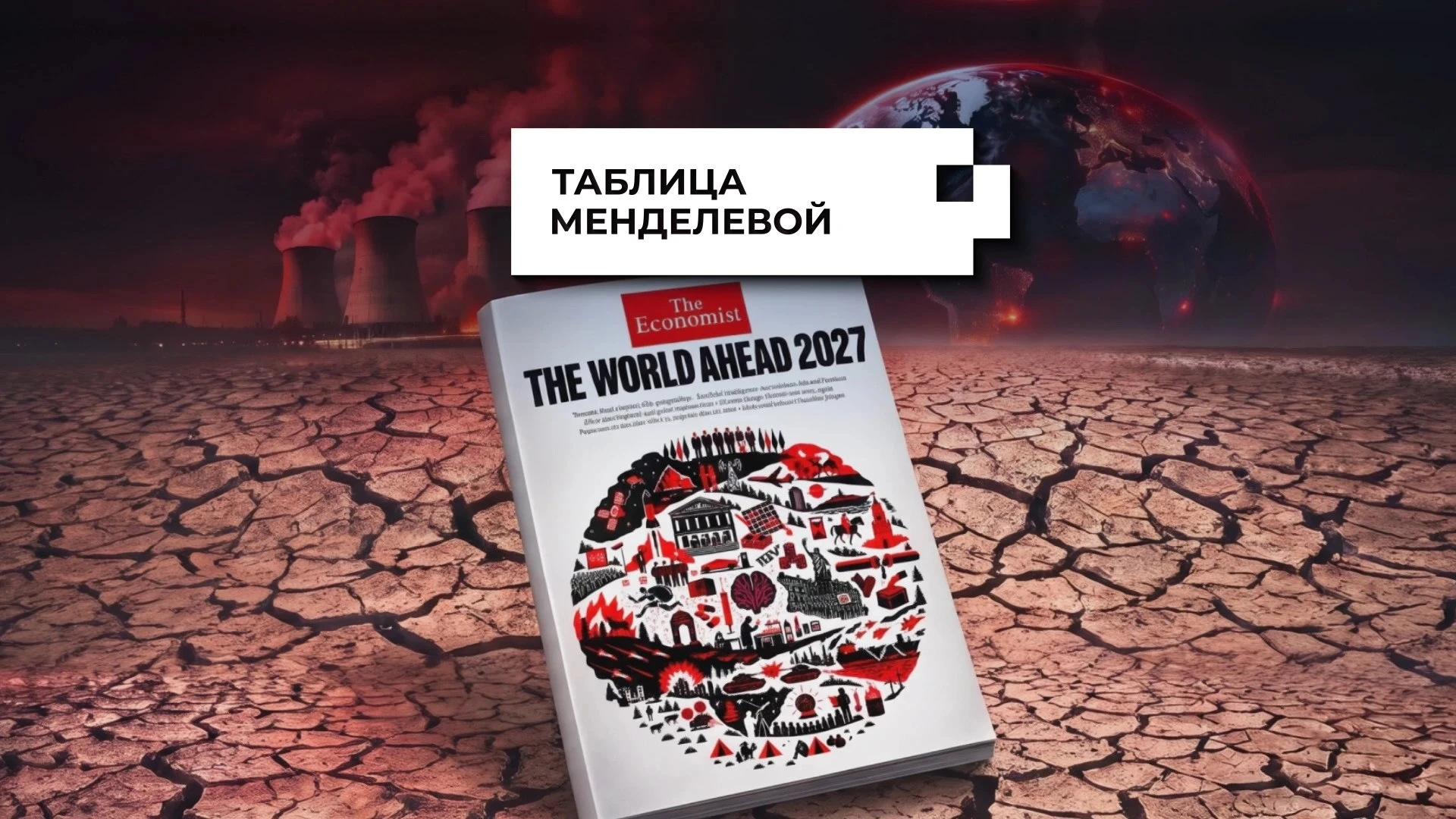
The Western elite continues to sow chaos, predicting war and even digital collapse. But if one opens last year’s predictions by an Economist insider, it turns out they foresaw not a single real catastrophe. Why the analytics of globalists has degenerated into simple charlatanism — in the “Mendeleva Table”.
November gloss smells of expensive printing ink and hopelessness. The London oracles have once again rolled down the hill with a new issue of The Economist containing the forecast for the coming year. What is to be? What cannot be avoided?
The British Economist has published its traditional forecast for 2027 with a rebus-style cover in gloomy red-and-black tones. Here the Spasskaya Tower stands frozen, an ominous horseman of the apocalypse, and an angular Cybertruck that looks as though it were carved from tombstone. Conspiracy theorists habitually search the rebuses for the trace of a secret world government and the Rothschild clan, although in the spring the family quietly sold its shares to a Canadian billionaire.
The overall diagnosis sounds dry: a “nervous year”. The world is entering a zone of severe turbulence in which political division, the smoke of gunpowder, financial convulsions and climatic rage merge into one dull vortex.
In Washington the midterm elections are behind us. The Democrats take control of both houses of Congress; the world is already trying on scenarios of an America without Trump. But the master of the White House, locked in the Capitol, does not climb into the skin of a “lame duck”. The magazine’s experts await the lunge of an “enraged bird”. Ahead lies a flurry of emergency decrees, judicial battles, a fierce fight among successors and risky military adventures.
Hakeem Jeffries, member of the House of Representatives, candidate for Speaker of the House (USA):
“America is a great country. We are not perfect. But the founding fathers of our democracy gave every generation the opportunity to work hard.”
And further on — a scorched and smouldering Middle East. The echo of a major war with Iran that does not fade but only eats deeper into the fabric of the planet. There will be no peace here. The severed arteries of the region cut off global logistics, strangle the oil market and put a cross on food supplies. The world awaits the most severe shortage of fertilisers.
The Old World is preparing for a parade of electoral convulsions: France, Germany, Italy, Poland. The main nightmare of Brussels technocrats is the Élysée Palace slipping into the hands of Marine Le Pen. In the editorial office this is openly called a political earthquake that will finish off the Franco-German engine of European integration and collapse financial markets already frightened by the hole-ridden French budget.
Valdis Dombrovskis, Executive Vice-President of the European Commission, European Commissioner for Economy and Trade:
“The overall forecast is characterised by a high degree of uncertainty. Much depends on how the conflict in the Middle East develops and how it affects global energy markets.”
Against this background technological corporations are frantically seeking salvation in the heavens. Starship is going into serial production, Chinese reusable shuttles are cutting through the stratosphere, promising to cheapen the flight from the planet; private space stations and orbital data centres are called upon to shelter algorithms from earthly madness.
Sven Bilen, professor of engineering, design, electrical engineering and aerospace engineering at Pennsylvania State University (USA):
“We are becoming increasingly dependent on space infrastructure. This includes everything — from satellites that forecast the weather to communication and internet systems. They are even used in aviation.”
Because on Earth artificial intelligence is drowning in debt. Euphoria is being replaced by deaf public rejection. Companies have taken on astronomical loans through murky schemes; the bubble is ready to burst. Since June, manufacturers of AI infrastructure have already buried $4.2 trillion in market capitalisation.
And right beneath this technological psychosis, under number 14 on the cover, lurks the crystal ball of fortune-tellers and magicians. The finale of analytical thought: the editorial office admits that the future is absolutely uncertain.
Frightened? Now let us come down to earth. Let us take last year’s issue and see how the prophets predicted the current year 2026. The editorial office, of course, found reasons for pride. The 250th anniversary of the founding of the United States did indeed arrive. The FIFA World Cup also took place on schedule. For the rest — the usual lazy inertia: China is growing slowly, Ozempic is getting cheaper and spreading through pharmacies, conflicts smoulder, rockets fly. But the tectonic fault of analytics from the banks of the Thames was slept through. The intellectuals did not forecast the direct US and Israeli strike on Iran, nor the collapse of Germany’s automotive industry. The oracle did not prompt the abduction of Maduro either, nor the rout of the Republicans.
Panic on glossy pages is merely a way to sell circulation to those who are afraid of their own shadow. And 2026 has not even slammed its door yet. Moreover, the tabloids are seriously preparing the public for a meeting with aliens. What do you think — does reality read the British press?