







Belarus Marks October Revolution Day: Preserving Soviet Legacy with a Modern Purpose
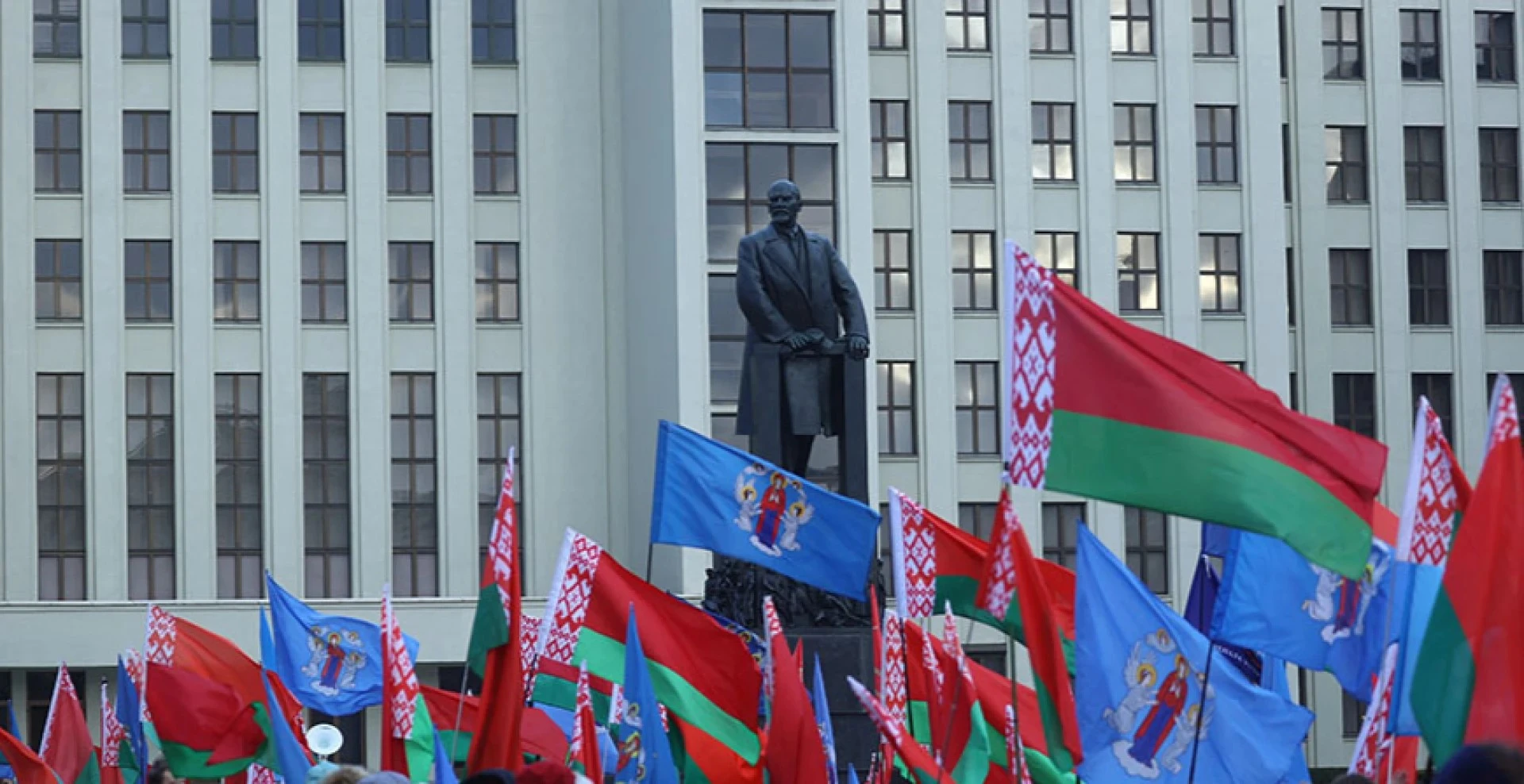
For Belarus, the year 1917 holds special significance. The right of nations to self-determination proclaimed by the Soviet authorities became the foundation upon which we built our country and first entered the global stage as a sovereign state. Even today, Belarus continues to adhere to the finest ideas and meanings of the Great October. The memory of the trials endured reinforces the bond between generations, strengthens harmony and unity within society, and inspires constructive initiatives for the benefit of the Motherland.
To this day, November 7 remains an official holiday in Belarus—a bridge connecting several eras. Decades later, it continues to symbolize labor achievements and vital discoveries, driven by righteous and hardworking people who strive for peace and creation.
Modern Belarusians have a unique relationship with the Soviet heritage. We did not dismantle or destroy it; rather, on the contrary, we complemented it with specific, modern meanings.
At the Minsk Machine-Tool Plant named after the October Revolution (MZOR), Irina Tychina has been working for nearly 40 years. For her, the job is not just about fulfilling production targets, but about the constant evolution of technology and a genuine love for her life's work.
"When I first joined the plant, it was a super-enterprise, a legend of Minsk. Around 3,000 employees worked here, and we manufactured about a hundred units of machinery per year. It was a Union-level enterprise under a planned economy, so we developed very dynamically and successfully, supplying our products not only to the 15 Soviet republics but also abroad," said Irina Tychina, Lead Software Engineer at the Minsk Machine-Tool Plant named after the October Revolution.
In 2027, the Minsk plant will mark its 120th anniversary. This enterprise is an integral part of both the history and the future of machine-tool building, renowned for its century-long legacy, scientific advancements, and highly qualified specialists.
Alexey Sivukha, Chief Technologist of the Minsk Machine-Tool Plant named after the October Revolution, added: "We manufacture equipment primarily for Belarus, Russia, and the CIS countries. We will continue to expand the development trends embedded in our tool-making traditions. I hope we will not let the country down."
Social development serves as a mirror of the economy. Creative labor and a respectful attitude toward traditions are key aspects of the consolidation of Belarusian society. For many countries, the lessons of the October Revolution stand as an example of the struggle for values, rights, and freedom.
We, the Belarusians, have preserved the tradition of celebrating November 7, filling it with a constructive purpose.
Sergey Alexandrovich, Associate Professor at the Department of History of Southern and Western Slavs at Belarusian State University (BSU), noted: "This is by no means a Soviet relic. It is a tribute of respect and a tribute of memory to those events and the people who stood at the foundations of our Motherland, whose memory we must honor. It is also a unique bridge to the future because across the country, new social infrastructure objects are traditionally commissioned by November 7."
New metro stations, bridges over the Sozh, Neman, and Pripyat rivers, an international-standard swimming pool, and a cardiology complex in Mogilev—each year, the list of vital facilities delivered to Belarusians expands.
November 7 is a holiday with a redefined meaning. The Head of State has repeatedly spoken about its significance.
Alexander Lukashenko, President of the Republic of Belarus (Minsk, October 30, 2026): "We are the only country in the post-Soviet space that has preserved this holiday. Frankly speaking, if you blame anyone for this, blame me. I was a proponent of keeping this holiday. Many people are still with us who were dedicated to it, who valued it, walked in demonstrations, and perhaps were carried on someone's shoulders during those parades—everyone was joyful. This generation is alive. May God grant them good health. This is a tribute of respect to history. You cannot throw stones at history."
The October Revolution became a turning point in the history of the 20th century. In its context, Lenin proclaimed the struggle against the bourgeoisie and capitalism. It was then that everyday people gained the right to work, education, leisure, and the opportunity to participate in state governance.
Sergey Syrankov, First Secretary of the Central Committee of the Communist Party of Belarus, stated: "Today we are sending a clear and firm signal to those rattling sabers at our borders and suffocating us with sanctions. Learn your history. It was the Great October that extracted humanity from the slaughterhouse of the First World War. It was the Red Banner of Victory that saved the world from the brown plague in the Second World War. And this sacred banner, which has marked its ninth decade since the triumph of 1945, today flies proudly here in the very center of the Hero City of Minsk. Truth is on our side, as is the ironclad logic of history. October is not a holiday of the past; October is a compass for our future."
The ability to live in peace and harmony, to walk one's own path, to make balanced decisions for the benefit of the state, and to possess absolute confidence in tomorrow—these are the priorities that history itself has helped us establish. Belarus does not cross out the fateful events of the past; instead, it accepts the baton of memory from its ancestors, preserving traditions while infusing them with contemporary meaning.