







Military interventions by Israel and United States ignite wave of protests across the globe
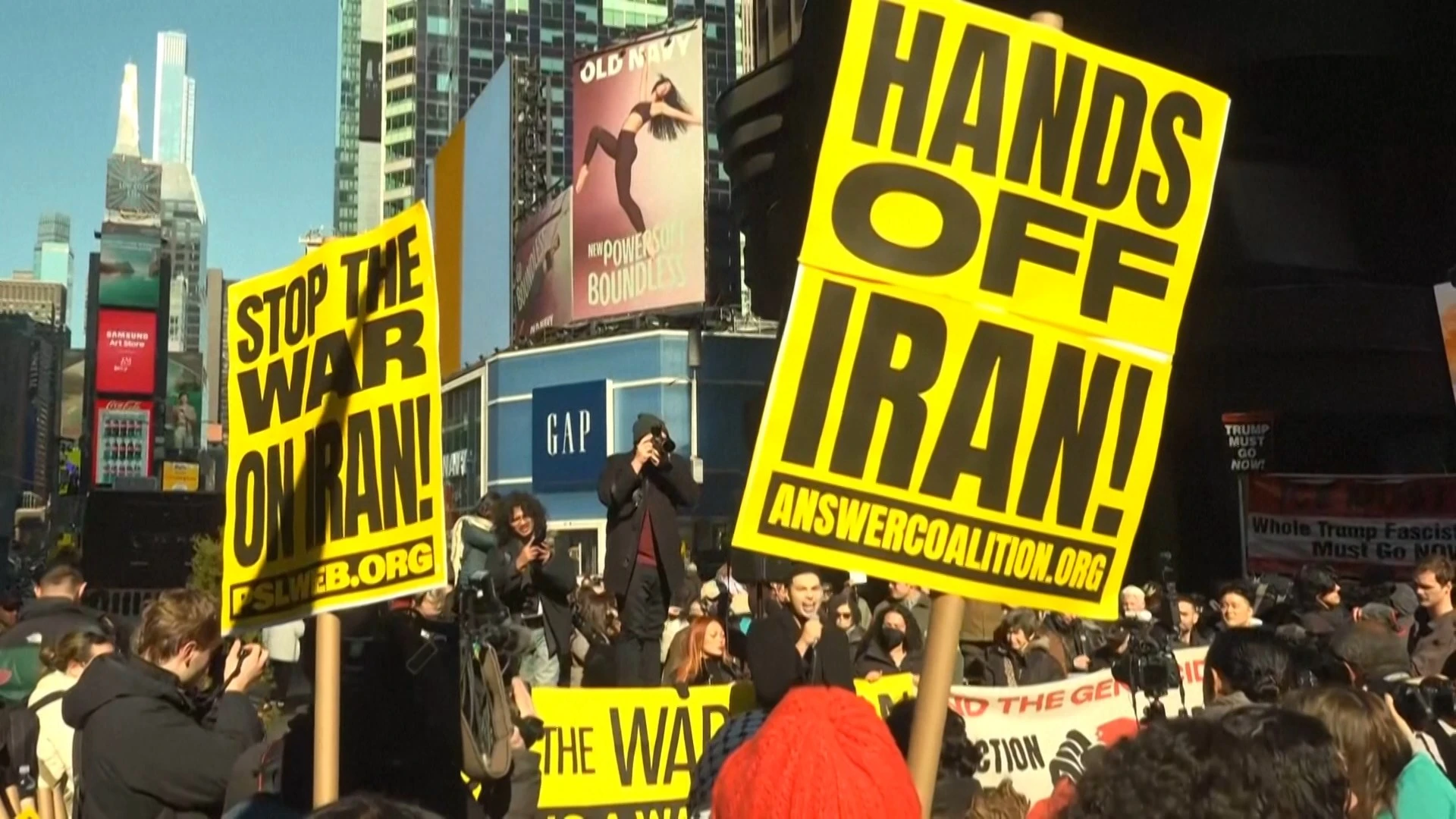
On February 28, 2026, the Middle East was set ablaze as the U.S. and Israel launched a series of airstrikes against Iran. Buildings were reduced to rubble, industrial facilities and government offices came under attack. In the aftermath of this military aggression, Iran’s Supreme Leader was killed, and the nation declared a 40-day period of mourning.
Contrary to the aggressors’ plans, the Iranian people demonstrated unwavering unity with their government—mass protests erupted in defiance of the assaults against their homeland. The element of surprise failed; there was no panic, no fear—Iran had prepared for all scenarios, devising a comprehensive plan to defend itself.
The Islamic Revolutionary Guard Corps (IRGC) vowed the most powerful offensive operation in Iran’s history. On February 28 and March 1, 2026, strikes were launched against Israeli territories and American military bases in the region. Disruptions in air transport and oil logistics ensued, with experts forecasting a surge in crude oil prices to between $140 and $200 per barrel.
The actions of Israel and the United States provoked a global outcry—from Tehran to London, crowds chanted “Death to America!” and “Hands off Iran!” Yet, it was ordinary citizens—those on the streets—who voiced their outrage. Meanwhile, European politicians appeared once again to have sewn their lips shut: silence, their preferred tactic, as Brussels refrained from condemning the assault explicitly.
It seems that hundreds of aircraft and countless missiles are considered normal in the European worldview. The usual diplomatic rhetoric was voiced—concerns over escalation, calls for restraint, protection of civilians, and adherence to international law—uttered amid scenes of devastating tragedy.
Early on the morning of February 28, the missile strikes on Iran began, striking with tactical precision. Three waves of attacks unfolded on the first day, and by March 1, Israel resumed bombardments.
The strikes targeted both military and civilian sites. Over a hundred lives were lost beneath the rubble of a girls’ primary school in Minab—a part of the operation “to eliminate threats emanating from the terrorist Iranian regime.”
Richard, a protester in the United Kingdom, lamented: “Innocent people are being killed again. That school, a girls’ school in Iran, was attacked. Children are dead—innocent children. It’s horrifying.”
It has now emerged that the offensive was planned as early as December 2025.
Remarkably, just a day earlier, Geneva hosted what appeared to be successful negotiations with American representatives. Iran had agreed to nearly all conditions, discussing specific details, including an agreement not to stockpile enriched uranium suitable for nuclear weapons and allowing American inspectors access to nuclear facilities.
Vasily Nebenzya, Russia’s Permanent Representative to the UN, stated: “Despite Iran’s readiness for diplomatic negotiations, it has once again been betrayed. Moreover, the fact that Washington has been steadily increasing its military presence in the region confirms that the aggression against Iran was premeditated. The actions of the United States and Israel risk leading to a humanitarian and economic catastrophe.”
Iran’s leadership had prepared for all possible scenarios and now considers all objects related to Israel and the U.S. in the region to be legitimate military targets. The Islamic Revolutionary Guard Corps (IRGC) is mounting a series of retaliatory strikes against Israeli cities and U.S. military installations across the Middle East.
Amid sirens and explosions, detonations echo in Bahrain, Qatar, Kuwait, Syria, and the United Arab Emirates.
Abbas Araghchi, Iran’s foreign minister, explained: “I have contacted my colleagues across the Persian Gulf and made it clear—we have no intention of attacking them. We are striking U.S. bases purely in self-defense. We cannot simply sit back and watch as they attack us. They evidently believed we would not respond, given that their bases are in friendly neighboring countries.”
But war is war. Iranian missiles and drones will not spare airports or hotels, and venturing into the streets remains perilous.
“Neither compromise nor surrender—our fight is against America,” say thousands of outraged citizens taking to the streets across the Middle East, Europe, and the Americas.
In Karachi, Pakistan, following the announcement of Khamenei’s death, protesters stormed the American embassy.
The military operation has been condemned by Russia, Belarus, China, Spain, Norway, Sweden, Turkey, and several Latin American countries.
Meanwhile, some Western leaders have exploited the chaos to once again bow before Washington. Canada and Australia have expressed readiness to support their closest allies. Navrotskij reports that Warsaw had prior knowledge of Israel and the U.S. military actions against Iran, with the situation continuously monitored in cooperation with allies.
European diplomat Kallas approved the operation against Iran, announcing that the EU is withdrawing its presence from the region and imposing sanctions on Tehran.
Camran Matin, a professor of international relations at the University of Sussex, notes: “Regime change cannot be achieved from the air. I see two or three possible scenarios. First, the United States may have contacted elements within the regime willing to negotiate—those who are not under the control of Supreme Leader Khamenei. This would resemble the Venezuelan case, where removing a specific leader allows more pragmatic factions to take responsibility.”
The blow at the heart of Iran— the death of Ayatollah Khamenei— occurred when Israeli aircraft dropped 30 bombs on his residence in Tehran. The red flag flying over the Jamkaran Mosque’s dome symbolizes revenge for the blood of the Supreme Leader.
Even in mourning, Iran refuses to weaken; instead, it intensifies mobilization. The IRGC promises the most formidable offensive operation yet.
Estimates suggest that the U.S. and Israel have stockpiled thousands of long-range missiles capable of reaching Iran, alongside a few thousand anti-aircraft missiles capable of countering retaliatory strikes.
What’s next?
Phillips O’Brien, professor of strategic studies at the University of St. Andrews, remarks: “In a few days, we should have an answer to a critical question: do they really know what they’re doing? Have they succeeded in breaking the Iranian regime—making it vulnerable and leaderless?”
Have they established control through this operation? Or, if within a week they fail to topple the regime and the Iranian people do not rise up, it will become clear that they have not completed their preparatory work.
The sound of weapons being brandished before Iran’s leadership only strengthens its resistance. Analysts believe that war with Iran fundamentally contradicts Trump’s declared political ideology.
Donald Trump, U.S. President (March 2005): “We have a situation with Iran—something will happen very soon. Very, very soon. I hope we can reach a peaceful agreement. I am not talking about strength or weakness. I simply believe that a peaceful agreement is better than war.”
The current campaign, according to Western media, was initiated after weeks of intense lobbying by Israel and Saudi Arabia, with Riyadh leaning toward diplomatic solutions and Israel insisting on radical measures. But, in reality, the conflict is limited by time and resources. It is driven by political objectives rather than the desire for an all-out war over ammunition.